
The story behind the tribute
Bamse: The Sea Dog Who Broke Up Fights
A remarkable life. A lasting bond. A story that deserves to be remembered.
The life behind the tribute
Remember Bamse.
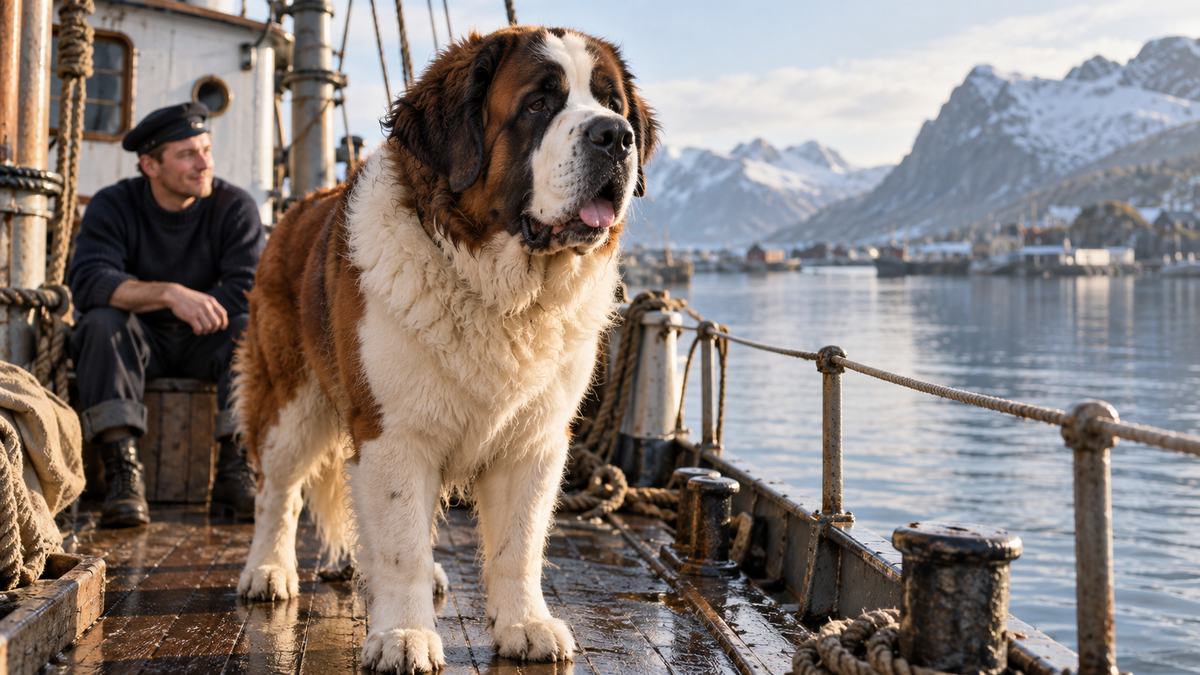
An enormous St Bernard was officially enlisted in a navy at war, rode a Scottish bus alone with his own bus pass, and once knocked a knife-wielding attacker into the sea to save a man he'd never met.This is the story of Bamse, a St Bernard who became the unofficial guardian of an entire Norwegian naval crew exiled far from home during the Second World War, and whose statue still faces out to sea toward the country he never got to return to.
A giant breed built to find people in trouble
The St Bernard is a giant mountain breed, developed over centuries in the Swiss Alps by monks who used the dogs' remarkable size, strength, and scenting ability to locate travelers lost or trapped in alpine storms. Everything about the breed's history is oriented toward one purpose above all others: finding people in danger and bringing them safely home. Bamse belonged to Captain Erling Hafto, who ran a Norwegian whaling ship called the Thorodd, and the big dog grew up right alongside the captain's own children, already a full and deeply beloved member of the family long before the war ever reached their part of the world.
War comes to Norway
In 1940, the Second World War reached Norway directly, as German forces invaded and occupied the country. The Thorodd, rather than fall under occupation, joined the Norwegian Navy in exile and made the dangerous crossing of the North Sea to reach Scotland. Bamse went with the crew on that voyage, and in an unusual gesture that speaks to how deeply he had become part of the ship's life, he was officially enlisted as a formal member of the ship's company, not a mascot kept informally aboard, but a recognized name on the crew roster itself.
A new home in Montrose
The Thorodd's new wartime home became the small Scottish fishing port of Montrose, a long way geographically, and further still emotionally, from the Norwegian coast most of the crew had grown up on, in a country that was itself fighting a desperate war of its own against the same enemy. The sailors stationed there were young, far from their families, and frequently homesick and frightened in the particular way that young men thrown into a war far from home often are. Bamse, in his own enormous and endlessly gentle way, took it upon himself to look after them.
Keeping the peace, literally
When crewmen began fighting with one another, as tired, stressed young sailors occasionally did, Bamse would simply walk over, rear up onto his back legs, and rest his huge front paws on their shoulders until the fight dissolved and they calmed down. When sailors stayed out too late drinking at the local Montrose pubs, Bamse went and fetched them himself, entirely unaccompanied, riding the local town bus alone, with his own bus pass hanging from his collar, specifically to track the men down and shepherd them back to the ship before they got into trouble.
A life worth remembering
A companion remembered far beyond his ship.
Two rescues, two lives saved
Bamse's protectiveness extended well beyond breaking up pub arguments and bus rides. On one occasion, in the nearby port of Dundee, a man attacked a Norwegian lieutenant commander on the quayside with a knife. Bamse, without any command to do so, charged the attacker, physically knocked him clear of the officer, and pushed him straight into the harbor water.
On another separate occasion, a sailor fell overboard into open water. Bamse jumped in after him without hesitation and dragged him back safely to shore.
A town's beloved dog
Montrose, as a whole, came to love Bamse as one of its own adopted residents rather than merely a visiting ship's mascot. His image appeared on postcards that were sent out and shared around the world during the war, a small, warm symbol from a Scottish port that had taken in an entire exiled Norwegian crew, and their enormous dog, as something close to family.
A funeral with full military honours
In July 1944, Bamse collapsed suddenly at the dockside in Montrose. His heart had failed. Hundreds of people turned out for his funeral in the days that followed: Norwegian sailors from the Thorodd and other ships, Allied servicemen stationed nearby, ordinary townspeople, and local schoolchildren who had grown up knowing him as a familiar, beloved figure around the port. He was buried with full military honours, a recognition very rarely extended to any animal, let alone one who had traveled so far from the country he had originally set out to serve.
Facing home across the water
Today, a life-size bronze statue of Bamse stands in Montrose, deliberately positioned facing out to sea, toward Norway. He was bred, by the deepest instincts of his breed's long history, to rescue travelers from the cold and the mountains of his homeland. Instead, far from that homeland himself, he found a different kind of people to rescue, an entire exiled naval crew, kept just a little less alone through a war that had taken them much further from everything they knew than any of them had ever expected to go.
Norway's government-in-exile, and a crew far from home
Following the German occupation of Norway in 1940, the legitimate Norwegian government relocated to London and continued directing the country's war effort from exile, while ships of the Norwegian merchant and naval fleets that had managed to escape occupied waters were reorganized to support the Allied cause from bases across Britain. Montrose became one of several Scottish ports hosting exiled Norwegian vessels and their crews throughout the war, communities that, by most surviving accounts, formed unusually close bonds with their host towns given the shared hardship of fighting a war while permanently separated from home, family, and in many cases any certain knowledge of loved ones' safety back in occupied Norway.
A story kept alive on both sides of the North Sea
Bamse's story has been actively preserved by veterans' associations in both Scotland and Norway in the decades since the war, including through a dedicated memorial fund that helped finance the Montrose statue, unveiled in 2006 with representatives from both countries in attendance. Children's books, documentary features, and school programs in both nations continue to use his story as an entry point for younger audiences into the wider, often overlooked history of Norway's wartime naval exile, a chapter of the Second World War that, without a dog as memorable as Bamse attached to it, might otherwise have remained comparatively unknown outside specialist military history circles.
Why his story still resonates
Part of what distinguishes Bamse from many other celebrated wartime animals is the sheer range of what he did. He wasn't recognized for a single dramatic rescue alone, but for a sustained pattern of looking after an entire crew's wellbeing over years, breaking up fights before they escalated, retrieving sailors who might otherwise have missed curfew and faced disciplinary trouble, and twice intervening directly in violent, dangerous situations involving people he had no formal duty to protect. That breadth is part of why Montrose has continued to treat him less as a wartime curiosity and more as a genuine former resident worth honouring on his own terms, decades after the war that brought him there ended.
There is also something quietly instructive in how specific his interventions were. Bamse did not simply patrol the ship or the docks in a generalized show of vigilance. He appeared to recognize particular kinds of trouble, a fight building between two exhausted, frustrated sailors, a knife drawn on the quayside, a man struggling in open water, and responded to each one differently, with exactly the kind of physical intervention it called for. Naval historians who have studied informal accounts from surviving Thorodd crew members note that this discernment, more than his size alone, is what made him so trusted by the men he served alongside. A very large dog is not automatically a useful one in a crisis; Bamse's value came from consistently choosing the right response to very different situations, over and over, across four years of wartime service far from the country that had first raised him.
Remember the name
Bamse at a glance
- Breed: St Bernard
- Owner: Captain Erling Hafto, Royal Norwegian Navy
- Ship: The Thorodd, based in Montrose, Scotland, after Norway's occupation
- Known for: Breaking up crew fights, fetching sailors from town, and rescuing two men from attack and drowning
- Died: July 1944, Montrose, Scotland, of heart failure; buried with full military honours
- Legacy: A life-size bronze statue of Bamse stands in Montrose, facing toward Norway
Further reading: The Bamse Story, official memorial site, Bamse: the Norwegian war dog remembered in Montrose, BBC News
Love Bamse's story? Shop the Bamse Sweatshirt and bring it home.
The story stays with us
Remember Bamse.
Explore the tributes inspired by Bamse's story, or meet another dog whose life deserves to be remembered.