
The story behind the tribute
Barry: The Alpine Rescue Dog
A remarkable life. A lasting bond. A story that deserves to be remembered.
The life behind the tribute
Remember Barry.
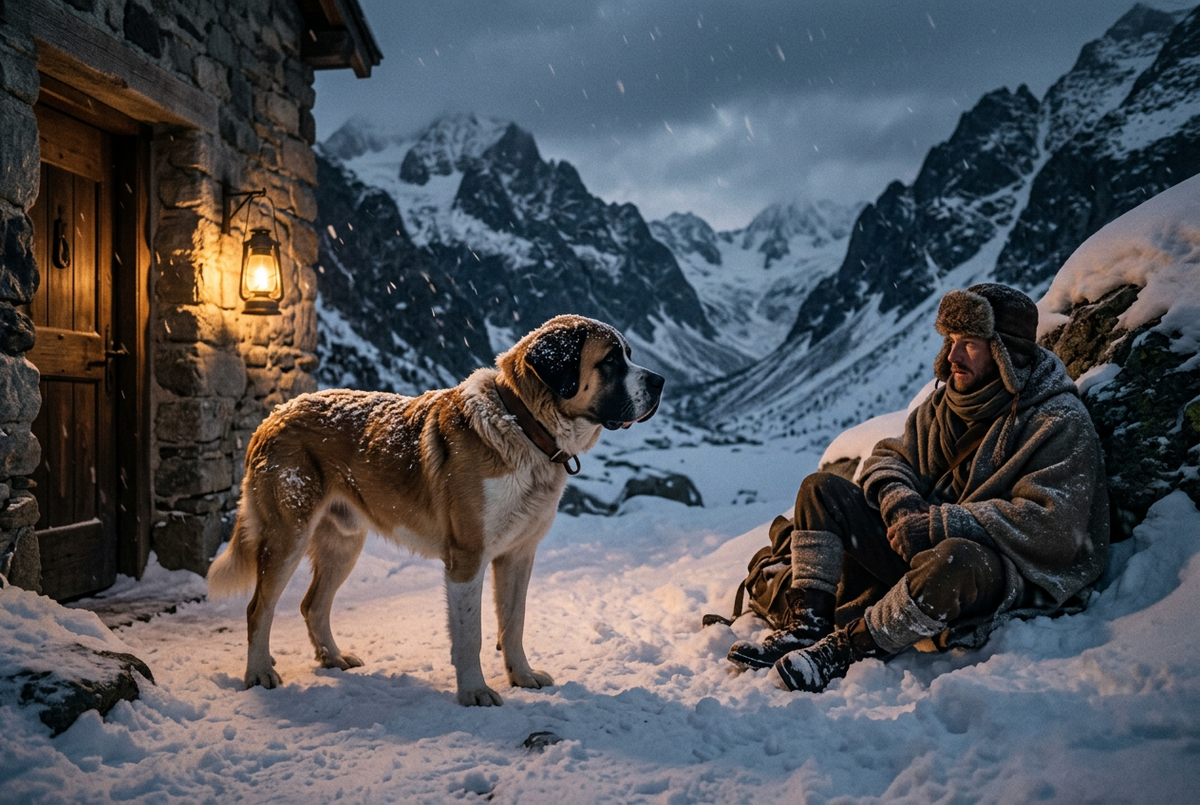
On a high Alpine pass where storms could erase the trail, a hospice dog became the subject of one of Europe’s most enduring rescue legends. Barry’s story is part history, part memory, and part mountain folklore.
A refuge above the valleys
The Great St Bernard Pass cuts between the valleys of Switzerland and Italy. For centuries, travelers crossed it on foot, carrying goods, news, and sometimes nothing more than the hope of reaching the other side. The route climbs into a landscape where weather can change quickly. Snow hides familiar ground, wind strips warmth from clothing, and fog makes a short distance feel endless. In this setting, a hospice operated by Augustinian monks offered shelter to people making the crossing.
The hospice was more than a building. It was a place of practical care, maintained by a religious community and sustained by a long tradition of welcoming travelers. In a mountain environment, helping someone in trouble meant knowing the terrain, reading the weather, and moving through conditions that could endanger the rescuer as well as the person lost. The dogs kept at the hospice became part of that world. They were working animals, bred and raised in a community where strength, steadiness, and an ability to cope with cold mattered.
One of those dogs came to be remembered as Barry. His life is usually dated from 1800 to 1814, and he is often described as a St Bernard. The story is more complicated than the familiar picture of a massive modern St Bernard with a tiny barrel of brandy. The breed’s appearance changed over time, and dogs at the hospice in Barry’s era were not necessarily identical to the present-day breed. Descriptions and later portraits vary. What remains consistent is the association between Barry’s name, the hospice, and the tradition of mountain rescue.
A dog among the rescuers
In popular accounts, hospice dogs went out in search of travelers caught in snow and poor visibility. The dogs’ strength and confidence could make them useful companions in difficult terrain. They could travel beside the monks, use their senses in weather that made human sight unreliable, and help locate people who had become separated from the route. The work was not a magical solution to the mountains. A dog could not make a blizzard safe or guarantee that a lost traveler would be found. But the animal’s presence could add another set of senses and another source of warmth and companionship to a dangerous search.
Barry became the best-known dog connected with this tradition. A popular tally credits him with saving more than forty people. The number appears often in retellings, but it is not possible to verify it as a modern rescue log. Records from the early nineteenth century are incomplete, and stories about exceptional deeds tend to gather details as they pass from one generation to the next. The figure belongs to Barry’s legend and reputation; it should not be presented as a precisely documented total.
The most famous rescue tale tells of a child found in the snow. In one version, Barry discovers a boy who is trapped or unconscious, warms him, and carries him toward safety. The image is unforgettable: a large dog moving through a white landscape with a small human life resting against him. It captures what people wished the hospice dogs could do and what they believed a loyal animal might accomplish in a crisis. Yet the details of this particular episode are not firmly established in the surviving record. It is best understood as a story attached to Barry, not as an eyewitness report whose every scene can be confirmed.
How a legend grows
Barry’s fame developed at the meeting point of real work and public imagination. Mountain rescue demanded courage and practical skill. The monks and travelers who depended on the hospice had reason to remember the dogs that accompanied them. Over time, the best-known dog became a character through whom people could picture the work: a faithful companion, alert in the snow, finding a stranger when no one else could.
Stories like Barry’s also answered a deeper human need. The Alps were not a gentle backdrop. They were a landscape where people could disappear in a single storm, and where the difference between safety and danger might be a roof, a guide, or a helping hand. A rescue dog offered a hopeful figure in that uncertainty. The animal did not argue, weigh the traveler’s status, or ask whether the person deserved help. In the story, the dog simply went out.
That emotional power does not require us to claim that every detail is factual. In fact, uncertainty can make the story more honest. We can respect the likely reality of working dogs at the hospice and the long tradition of assistance on the pass while admitting that the exact shape of Barry’s individual rescues has been embellished or lost. The distinction between history and legend is not a wall that prevents us from caring. It is a way to care without turning memory into false certainty.
The dog remembered after his death
Barry died in 1814, according to the dates most often given. His remains were preserved and became part of the public memory of the hospice dogs. A famous Barry is associated with a display at the Natural History Museum in Bern, where a mounted dog has long been connected with the rescue tradition. The image makes the past feel close, but museum displays also reflect later choices about how a life should be represented. The preserved animal is an artifact, while the stories told around him are a mixture of historical record and cultural memory.
By the nineteenth century, the St Bernard had become an emblem of mountain rescue. Paintings, prints, and popular accounts spread the image far beyond the pass. The dog came to stand for kindness in an unforgiving landscape. The famous barrel around the neck is more familiar from art and popular culture than from reliable evidence of standard rescue practice. It is an appealing detail, easy to recognize, and therefore repeated. But it should not be mistaken for proof that hospice dogs routinely carried brandy for people found in the snow.
As the breed became internationally recognizable, the dog’s physical form changed through breeding and changing expectations. Modern St Bernards are generally heavier and more massive than many earlier hospice dogs are thought to have been. Barry’s fame often causes viewers to imagine him through the modern breed standard, yet the nineteenth-century working dog belonged to a different moment in the breed’s development. The distinction matters because Barry was not a mascot invented to match a later picture. He was remembered through an evolving tradition.
A life worth remembering
A story of care in a place of danger.
What rescue means in the mountains
To imagine the work behind the legend, begin with the ordinary facts of a mountain crossing. A traveler might be exhausted, poorly equipped, injured, or unable to see the route. A searcher would need to move carefully, conserve strength, and return before worsening weather closed the pass. A dog could assist, but the rescue depended on a network of human knowledge and care: the hospice, the monks, the people who maintained routes, and those who carried information from one valley to another.
Dogs do not need to know the full story of a rescue to participate in it. They respond to scent, sound, movement, training, and the presence of familiar people. Their confidence and willingness to remain close can be valuable in a crisis. A story that says Barry saved a traveler may condense a complicated effort into a single name. That is one reason a memorable dog can overshadow the people and systems around him. A fuller account gives the animal his place while remembering the community that made rescue possible.
The pass itself has changed. Roads, transport, weather forecasting, communications, and modern rescue services have transformed travel through the Alps. Yet the story continues because it concerns a problem that has never vanished: people can become vulnerable in places they do not fully control, and help often arrives because others choose to go looking. Barry gives that choice a face, or rather a muzzle and a pair of alert ears.
A story worth telling carefully
Barry’s name has lasted for more than two centuries. That endurance owes something to the drama of the rescue legend, but also to the plain fact that people want to believe that courage can take many forms. The hospice dog who entered a storm for a stranger is a powerful companion to the human rescuer. His story is especially moving because the dog could not understand the public honors or the future fame that would gather around him. He belonged to the work itself.
We should not turn that thought into invented certainty about what Barry felt or intended. A dog’s behavior can be observed, remembered, and interpreted, but we cannot know his private experience from a legend. We can say that he was remembered as a working hospice dog and that his name became linked to rescue. We can say that generations of people found in him an image of steadiness and aid. We can also say that the exact tally of lives saved and the details of the best-known child rescue remain uncertain.
Those limits leave plenty to admire. The Great St Bernard Pass required people to help one another in conditions that could make help dangerous. Dogs were part of that history. Barry became the most famous name attached to them, a bridge between the work of an Alpine hospice and the imagination of readers who may never see the pass. His story invites us to remember both the real landscape and the legend laid over it: a high route, a refuge, a dog trained for work, and a long human gratitude for help received when the snow was closing in.
Historical note
Barry is traditionally associated with the Great St Bernard Hospice and is commonly credited with saving more than forty people, though exact totals and specific rescue anecdotes cannot be independently verified. Accounts also note that the hospice dogs of his era were not necessarily identical in appearance to the modern St Bernard. This retelling separates documented context from the most famous legend. See Barry (dog) on Wikipedia for a summary of the tradition and its uncertainties.
Love Barry's story? Shop the Barry Sweatshirt and bring it home.
The story stays with us
Remember Barry.
Explore the tributes inspired by Barry's story, or meet another dog whose life deserves to be remembered.