
The story behind the tribute
Bretagne: The Last 9/11 Search Dog
A remarkable life. A lasting bond. A story that deserves to be remembered.
The life behind the tribute
Remember Bretagne.
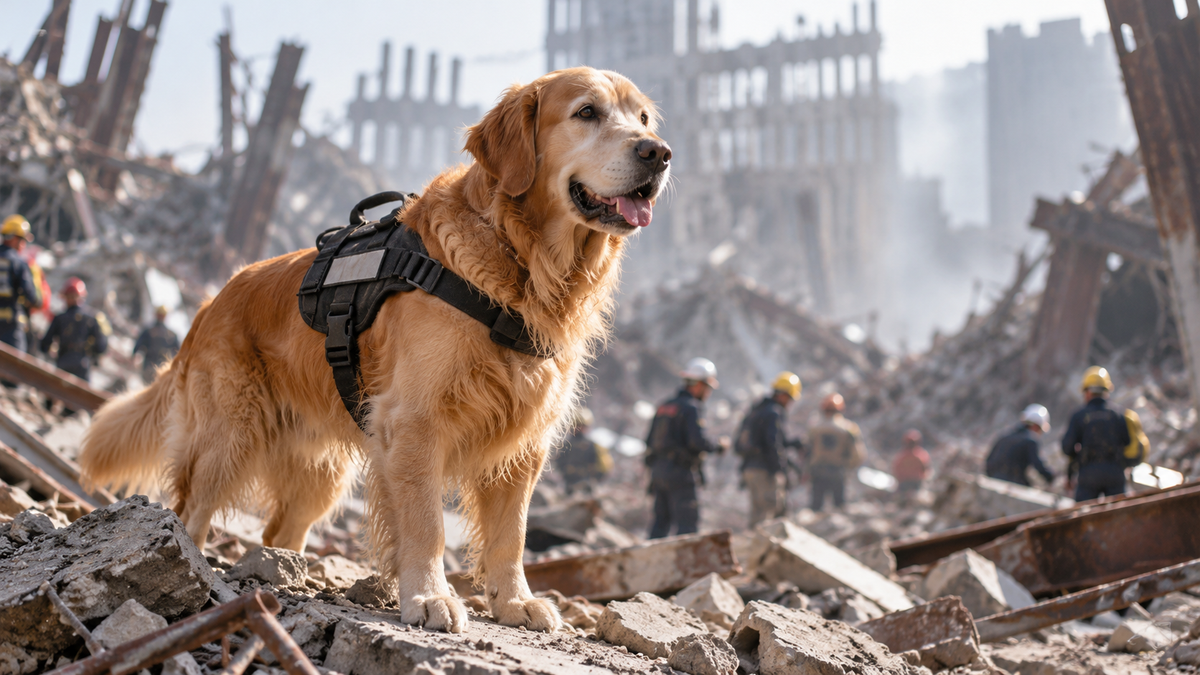
She searched Ground Zero for ten days after September 11th. Fifteen years later, as she walked her final steps toward the vet, the firefighters she had worked beside lined up on both sides of the path to salute her.This is the story of Bretagne, a Golden Retriever search-and-rescue dog believed to be the last surviving search dog from the September 11th attacks, and whose quiet second career, comforting shy schoolchildren, was just as remarkable in its own way as her first.
A gentle mouth, trained for the hardest work
Golden Retrievers are known among working dog breeds for an exceptionally gentle mouth, a trait originally bred for retrieving game birds without damaging them, precise enough that a well-trained Golden can carry something as delicate as a live bird for miles without leaving a single mark. Bretagne, born in Texas in 1999, put that same careful gentleness to an entirely different, far more demanding use over the course of her life. Her owner, Denise Corliss, a volunteer firefighter, began training her for search-and-rescue work from the time she was just eight weeks old, with the specific goal of finding people trapped beneath collapsed buildings.
Her first real job: Ground Zero
Bretagne was only two years old when she received her first major real-world assignment. September 2001, Ground Zero, New York City. The World Trade Center towers had fallen. The ruins were still actively burning in places. Thousands of people remained missing in the wreckage.
Bretagne and Denise searched continuously for ten full days.
Climbing through steel, smoke, and dust
Together they climbed through twisted structural steel, through thick dust and lingering smoke, first searching specifically for anyone who might still be alive in the wreckage, and later, as hope of finding survivors faded, helping locate those who had not made it. In the moments when exhausted firefighters finally sat down to rest between shifts, Bretagne would often wander over to them entirely on her own, without any command, and lean in close against them, an instinct for offering comfort that no search-and-rescue training manual had specifically asked for, but that became one of the things people who worked alongside her remembered most.
A career that kept going
Bretagne's working life didn't end at Ground Zero, far from it. She went on to search after three separate major hurricanes in the years that followed, Rita, Katrina, and Ivan, each time applying the same patient, methodical searching technique to a very different kind of wreckage left behind by very different disasters.
A life worth remembering
Remember the dog behind the service.
A second calling: reading with children
When she turned nine years old, Bretagne formally retired from active search-and-rescue work. But she went on to find one more, entirely different job for herself. Every week after her retirement, she visited a local primary school, where shy children who were too nervous or self-conscious to read aloud in front of their classmates were instead encouraged to sit beside her and read quietly to her alone.
She never laughed at a mispronounced word. She never corrected anyone. She simply listened, patiently, exactly as long as each child needed her to.
Her last morning
In 2016, Bretagne turned sixteen years old, an advanced age for a large breed dog who had spent much of her working life in physically punishing conditions. Her kidneys began to fail. On what would turn out to be her last morning, Denise drove her to the veterinarian's office for the final time.
When they arrived, firefighters and rescue workers from the department, people who had known Bretagne for years, some of whom had worked alongside her at Ground Zero itself, were already standing in two lines on both sides of the path leading to the door. As Bretagne walked slowly between them for the last time, they saluted her formally, exactly as they would a fallen colleague.
Later, her flag-draped remains were carried to Texas A&M University's veterinary college, where staff and students saluted her once again. She was believed, at the time of her death, to be the last known living search-and-rescue dog who had worked at Ground Zero in the immediate aftermath of the attacks.
She walked into the ruins for them
Bretagne walked into wreckage that most people would instinctively run from, not just once at Ground Zero but repeatedly across a long working career that spanned a defining national tragedy and three separate major hurricanes afterward. On her very last day, the people she had once searched tirelessly for simply lined up to walk her out of that life with precisely the honour she had earned, one collapsed building, and later one frightened, stammering child, at a time.
A rare survivor among the Ground Zero search dogs
Approximately three hundred search-and-rescue dogs are believed to have worked at Ground Zero and the Pentagon in the days and weeks following the September 11th attacks, drawn from search-and-rescue teams across the United States and, in some cases, from abroad. In the years that followed, researchers at several veterinary schools tracked the long-term health outcomes of these working dogs, partly to understand what exposure to the dust, debris, and chemical hazards of the site might mean for their lifespans and wellbeing. By the time of her death in 2016, Bretagne was widely reported, including by Texas A&M's veterinary researchers who had been tracking her for years, to be the last of that original group of search dogs still living, a milestone that transformed her death from a private family loss into a moment of broader public significance, marking the symbolic end of a specific chapter of 9/11 history.
A second career that reflected the same instincts
The reading-therapy program Bretagne took part in during her retirement, sometimes referred to informally as a "reading-to-dogs" program, is a model used in schools and libraries across the United States, built on research suggesting that children who struggle with reading confidence often relax and improve more quickly when reading aloud to a calm, non-judgmental animal rather than to a teacher or classmate. For a dog whose working life began amid the wreckage of a national tragedy, her transition to quietly supporting individual children with their reading offered a striking, deliberate contrast, the same patient attentiveness that had once helped locate survivors in rubble, redirected toward a far gentler, if no less meaningful, purpose.
A record built on preparation most people never saw
By the time Bretagne reached Ground Zero at age two, she had already spent nearly two years in structured training, learning to navigate unstable surfaces, tune out distracting noise and movement, and signal a find reliably even under extreme physical and sensory stress, the invisible groundwork behind what looked, to onlookers at the site, like simple, instinctive searching. Denise Corliss has spoken in later interviews about how little of that preparation is visible in the finished product: years of repetition in training rubble piles, built specifically to simulate disaster conditions, long before a dog is ever certified and deployed to a real site. Bretagne's ten days at Ground Zero represented the culmination of that invisible work, not a one-off display of natural talent alone.
Her later hurricane deployments reinforced the same pattern. Search-and-rescue dogs are typically recertified at intervals throughout their careers, and Bretagne maintained her working certification across multiple disaster types, collapsed-structure searches at Ground Zero, and the very different debris-field searches required after Hurricanes Rita, Katrina, and Ivan, a versatility that relatively few search dogs are asked to demonstrate across such a broad range of disaster conditions within a single working lifetime.
Honoured well beyond her own department
News of Bretagne's death drew tributes not only from the Texas volunteer fire community she served with directly, but from search-and-rescue organizations, veterans' groups, and school districts across the country who had followed her story through the years of coverage her Ground Zero work and her later reading program had each generated separately. Several news outlets specifically noted that her funeral procession drew comparisons to those typically reserved for fallen human first responders, a level of formal, public ceremony rarely extended to a working dog, and one that reflected just how completely her two very different careers, disaster search and classroom companionship, had earned her a place in the wider public's affection, not only in the eyes of the firefighters who had known her personally for most of her sixteen years.
Remember the name
Bretagne at a glance
- Breed: Golden Retriever
- Born: 1999, Texas
- Owner/handler: Denise Corliss, volunteer firefighter
- Known for: Ten days of search-and-rescue work at Ground Zero following September 11, 2001; later searches after Hurricanes Rita, Katrina, and Ivan
- Later life: Reading-therapy dog at a Texas primary school after retiring from search and rescue
- Died: June 2016, at sixteen years old, believed to be the last living search dog from Ground Zero
Further reading: Bretagne, 9/11 Search-and-Rescue Dog, Dies at 16, The New York Times, Texas A&M College of Veterinary Medicine tribute to Bretagne
Love Bretagne's story? Shop the Bretagne Sweatshirt and bring it home.
The story stays with us
Remember Bretagne.
Explore the tributes inspired by Bretagne's story, or meet another dog whose life deserves to be remembered.