
The story behind the tribute
Buddy: The Dog Who Called 911
A remarkable life. A lasting bond. A story that deserves to be remembered.
The life behind the tribute
Remember Buddy.
At a 911 call centre, a dispatcher kept asking if there was somebody there who could speak. On the other end of the line, a dog just kept barking, and refused to hang up.This is the story of Buddy, a German Shepherd trained to dial for help the moment his owner's seizures struck, and the dog whose barking down a phone line became one of the more remarkable 911 recordings ever broadcast on national news.
Bred to keep watch and raise the alarm
The German Shepherd is a breed built, through more than a century of selective working breeding, around vigilance, to guard, to notice small changes in its environment, and to raise the alarm the instant something goes wrong. It is this same alertness and problem-solving instinct that makes the breed so widely used in police, military, and increasingly in medical-alert service work. Buddy's human was Joe Stalnaker, a man in Arizona who lived with a seizure disorder that could strike at almost any time, often with little or no warning, and that left him physically unable to call for help himself once a seizure actually began.
Trained for one specific emergency
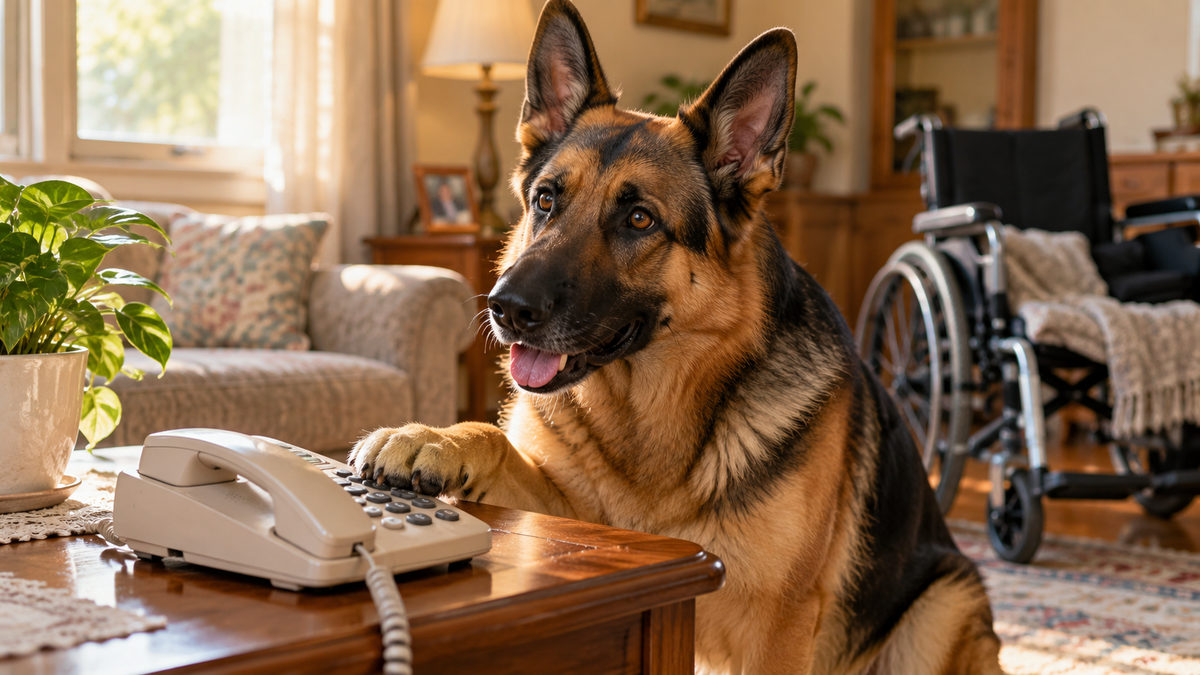
Buddy was trained specifically for that exact moment. Joe set up and programmed a cordless telephone so that if Buddy bit down firmly on one particular speed-dial button, it would automatically connect to 911. It was a deceptively simple piece of training, built entirely around a single, highly specific purpose: give the dog a reliable way to summon emergency help in the exact moment the man himself could not.
One day in 2008
One day in 2008, Joe was at home alone when a seizure struck without any real warning. He collapsed suddenly to the floor, unable to move or speak, exactly the scenario Buddy had been trained for.
Buddy took the cordless phone in his mouth, located the programmed button by touch, and pressed down on it.
"Hello, this is 911"
At the emergency call centre, a dispatcher answered the incoming call: "Hello, this is 911." No human voice responded.
"Hello. Can you hear me?"
On the other end of the line, the dispatcher could hear a dog whimpering, and then barking steadily into the receiver.
"Is there somebody there you can give the phone to?"
Buddy kept barking. He didn't drop the phone. He didn't hang up. He stayed on the line, continuing to bark, in what the dispatcher quickly came to recognize as a deliberate, sustained signal rather than background noise.
A life worth remembering
A familiar voice can become a lifeline.
Three minutes that mattered
The dispatcher, hearing a dog that was clearly refusing to disconnect from an open emergency line, made the call to send officers directly to the registered address rather than dismiss it as a false alarm. They arrived at Joe's home roughly three minutes later. Buddy was still barking steadily into the phone when officers came through the door.
Inside, they found Joe unconscious on the floor. He was taken immediately to the hospital for treatment, and two days later he was discharged and back home again, with Buddy waiting for him there.
Not the first time
Remarkably, this wasn't an isolated, one-off incident. Police later confirmed that Buddy had successfully called 911 for Joe on two separate previous occasions as well, using the exact same programmed phone. Three seizures, across an unspecified period. Three separate calls. Three times, it was Buddy, acting entirely on his own trained initiative, who brought emergency help to a man who could not call for it himself.
A recording the world heard
The recording of that 2008 emergency call was subsequently played on news broadcasts around the world, presented as a striking real-world example of just how far a well-trained service dog's usefulness can extend. People heard the dispatcher's voice, calm and methodically searching for any sign of a human response, and a dog answering back in the only language genuinely available to him, not with words, but by simply, stubbornly refusing to let the emergency line go dead until real help finally arrived at the door.
Living with a seizure disorder, and the role a trained dog can play
For people living with seizure disorders, one of the most dangerous moments is often not the seizure itself but the period immediately afterward, when a person may be unconscious, disoriented, or simply unable to summon help on their own at the exact moment they need it most. Seizure-alert and seizure-response dogs, as a specific category of service animal, are typically trained to perform one of two distinct roles: either learning to detect subtle physiological changes that precede a seizure and warning their owner in advance, or, as in Buddy's case, learning a specific physical response to perform once a seizure has already begun, such as activating a pre-programmed emergency call. Both approaches require extensive, patient training, and success stories involving dogs genuinely improvising beyond their core training, as Buddy appeared to do by staying on an open line until help physically arrived, are relatively rare even within this specialized field.
A case still referenced in service-dog training circles
Buddy's 2008 call has continued to be referenced in subsequent years by service-dog training organizations and emergency-dispatch training materials alike, cited as a real-world example of how a relatively simple piece of training, biting down on one specific button, can be combined with an animal's own instinctive persistence to produce an outcome well beyond what the original training session was narrowly designed to achieve. For Joe Stalnaker, the practical result was considerably simpler to describe than any of the broader discussion it generated: on three separate occasions, a dog who could not speak nonetheless made sure that someone came.
Why staying on the line mattered so much
Modern 911 dispatch protocols are built, in large part, around keeping a caller on an open line for as long as possible, since a connected call, even a silent or confusing one, allows dispatchers to trace the originating address and keep the channel available for any further information that might come through, whereas a disconnected call forces them to work from incomplete data alone. Buddy's extended barking, however unintentional in its deeper technical significance, accomplished exactly what the protocol depends on: it kept the line open long enough for the call to be traced and officers to be dispatched to the correct address with confidence, rather than relying on guesswork from a call that cut off after only a few seconds of confused noise.
Joe Stalnaker has said in subsequent interviews that what struck him most, hearing the recording played back afterward, wasn't that Buddy had managed to dial the phone, that part had, after all, been deliberately trained, but that he had stayed on the line barking for as long as he did, well past the point any specific command had told him to, as though he understood on some level that hanging up meant losing the help that was coming.
A simple piece of equipment, carefully adapted
The programmed speed-dial phone Joe Stalnaker set up for Buddy was, at its core, an ordinary piece of household technology repurposed for a very specific medical need, long before smartphone-based medical alert systems became widely available to consumers. Families managing seizure disorders and similar conditions in the years before more sophisticated alert technology existed often relied on exactly this kind of improvised adaptation, training a dog to interact with existing, everyday equipment in a way that compensated for what the person themselves could not do in the critical moment. Buddy's success with the programmed phone became, in a modest way, an early real-world demonstration of how much a trained animal could extend the reach of even very basic assistive technology, well before more specialized commercial devices caught up with what a well-trained dog and a cordless phone had already proven possible.
A story still used to teach the basics of training
Dog trainers specializing in medical-alert and service work have continued to reference Buddy's case in introductory training materials, not primarily for the technical sophistication of the training involved, which was genuinely simple, but as an example of how a single, well-executed trained behaviour can carry disproportionate real-world weight when it is matched precisely to the specific emergency a person actually faces. The lesson often drawn from his story is less about teaching a dog an impressive trick, and more about identifying, with real precision, the exact moment a person is most vulnerable, and building one reliable, repeatable response specifically for that moment alone.
Remember the name
Buddy at a glance
- Breed: German Shepherd
- Owner: Joe Stalnaker, Arizona
- Known for: Dialing 911 by biting a programmed phone button during Joe's seizures, and staying on the line barking until help arrived
- Confirmed calls: Three separate occasions, per police records
- Legacy: The 2008 call recording was broadcast internationally as an example of a service dog's training in action
Further reading: Dog calls 911 to save owner's life, ABC News, Dog dials 911, saves owner's life, CBS News
Love Buddy's story? Shop the Buddy Sweatshirt and bring it home.
The story stays with us
Remember Buddy.
Explore the tributes inspired by Buddy's story, or meet another dog whose life deserves to be remembered.