
The story behind the tribute
Capitán: The Dog Who Waited
A remarkable life. A lasting bond. A story that deserves to be remembered.
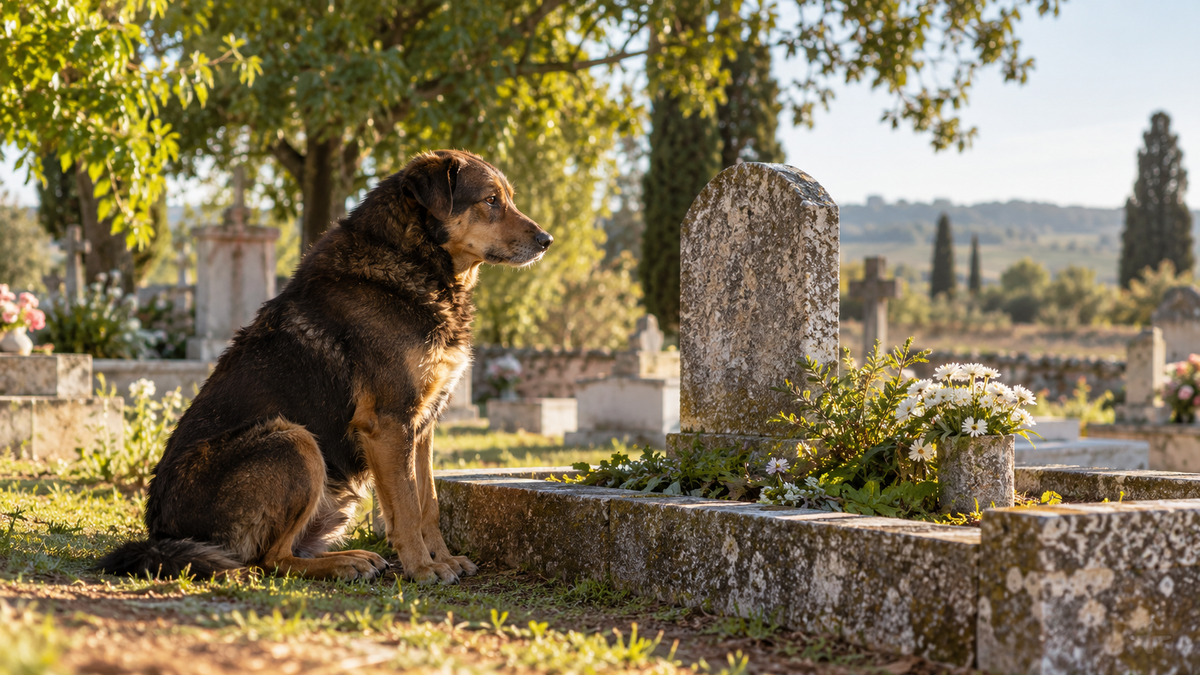
The life behind the tribute
Remember Capitán.
For eleven years, a German Shepherd mix in a small Argentine city found his way, on his own, to one grave in a cemetery he had never been taken to, and no one has ever fully explained how.This is the story of Capitán, a dog whose loyalty outlasted every attempt to understand it, and who turned an ordinary cemetery in Villa Carlos Paz, Argentina, into a place people now visit specifically to see where he kept watch.
A guard dog, by breed and by choice
The German Shepherd was developed in Germany at the end of the nineteenth century, bred above all for intelligence, trainability, and an unusually strong instinct to attach to one handler or one family. Herding breeds in general are built around the idea of choosing a flock and never letting it out of sight; the German Shepherd took that instinct and, through more than a century of selective breeding for police, military, and guide work, sharpened it into something closer to devotion. Capitán, a German Shepherd mix, carried that inheritance intact, even without a formal pedigree behind him. He lived in Villa Carlos Paz, a small tourist city in the hills of Córdoba Province, with his owner, Miguel Guzmán, and Miguel's family. By every account that survives him, Capitán was devoted to Miguel specifically, the kind of dog who orients his whole day, his whole sense of structure, around one particular person's comings and goings, and treats every other relationship as secondary to that one.
A loss with no goodbye
In March 2006, Miguel died suddenly in a hospital in another city, away from home. For a family already reeling from the shock of losing him, the practical business of a funeral moved quickly: his body was brought back for a wake, and from there taken directly to the cemetery for burial. Capitán was not part of any of it. He never attended the wake. He was never walked to the funeral. He was never shown, even once, where his owner had been laid to rest. For a dog whose entire sense of order ran through one person, that person simply stopped coming home one day, with no ceremony a dog could take part in and no explanation that could possibly reach him.
It is worth pausing on how ordinary, and how common, this kind of disappearance is for a family pet. Dogs are rarely included in funeral rites, and there was nothing unusual in the Guzmán family's decision, it is simply what nearly every family does. What makes Capitán's story remarkable is not that he was excluded. It's what he did afterward.
He disappeared, and then he was found
Some time after Miguel's death, Capitán went missing from the family home. They searched for him in the usual places and feared the usual outcomes, that he had run off for good, gotten lost, or worse, died somewhere alone, perhaps hit by a car on one of the city's roads. There was no reason to think of the cemetery. As far as anyone in the family knew, the dog had never once been taken there.
Then Miguel's widow and son made a visit to his grave, as grieving families do, to tend it and sit with their memories for a while. When they arrived, Capitán was already there, lying beside it, as though he had simply been waiting for them to catch up.
No one had shown him the way
According to the cemetery's director, who later spoke to journalists who came from around the world to cover the story, Capitán had not simply wandered toward a familiar scent carried from a single prior visit, because there had been no prior visit. The staff described watching him arrive on his own on a separate occasion, after the family had taken him home again, and move through the grounds methodically, row by row, checking one grave after another, until he reached the one that was his. Nobody had carried him there the first time. Nobody had marked a path. Whatever sense he was using, scent carried on Miguel's own clothing or belongings at the wake, some recollection of a route he might have half-seen from a car window, or something harder to name, it was his alone.
The family, moved and more than a little unsettled by what they were witnessing, took him home again. He went back to the cemetery. They brought him home a second time. He went back again. Eventually, recognizing that this was simply where the dog had decided he needed to be, they stopped trying to keep him away. The cemetery workers, who by then had come to recognize him on sight, began feeding him and looking out for him instead of treating him as a stray that had wandered onto the grounds.
A life worth remembering
Some bonds leave a place in our hearts forever.
A routine that lasted more than a decade
Every evening, as the light faded over the rows of headstones, Capitán lay down beside Miguel's grave. That was the pattern, repeated without apparent exception, for year after year: one year, then five, then ten. The cemetery let him stay. When he needed medical care, they took him to the vet. In every meaningful sense, he became a permanent resident of the grounds who happened to be a dog rather than a groundskeeper, tolerated at first, and in time, genuinely cared for by people who had never met Miguel Guzmán themselves but had come to understand, through Capitán, something about what he must have meant to the dog who refused to stop visiting him.
Growing old where he chose to be
Age caught up with Capitán the way it eventually catches up with any dog who has lived a long, full life. His eyesight failed until he was nearly blind. Walking the grounds, once effortless, became slow and difficult. His kidneys began to fail, a common and serious condition in aging large-breed dogs. By then, the cemetery staff who had watched him arrive as a grieving, searching stray more than a decade earlier had become something like his second family. When the time came that he could have been taken elsewhere for end-of-life care, in a clinic among strangers, they made the decision instead to let him stay in the one place that was calm and familiar to him, the place he himself had chosen, against every obstacle, year after year.
In February 2018, Capitán died in the cemetery, beside Miguel's grave. He had kept that vigil for roughly eleven years, through Argentine summers and winters, through every change the cemetery grounds themselves went through in that time, never once relocating his loyalty anywhere else.
A statue where he chose to lie
Today, a statue of Capitán stands in that same cemetery in Villa Carlos Paz, not a generic tribute built somewhere convenient, but a marker placed exactly where a dog once insisted, against every obstacle and without a single person's help, on being exactly where he believed he needed to be. The story spread well beyond Argentina in the years after his death, covered by international news outlets as one of the more striking documented examples of a dog's attachment outlasting its owner by over a decade.
Visitors who come to see the statue often leave without a tidy scientific explanation for how he actually did what he did, how a dog with no prior visit to a cemetery found one specific grave among hundreds, more than once, on his own. They leave instead with the simple fact of it, which in the end may be the more important part of the story: nobody showed him the way, and he found it anyway, and for eleven years, he never truly left.
Science without a tidy answer
Researchers who study canine cognition and scent tracking have documented, in controlled settings, that dogs can follow trails using a combination of ground scent, airborne scent, and remembered landmarks over distances most owners would never expect. None of that research, though, cleanly accounts for a dog navigating to a specific, previously unvisited location inside a large, visually repetitive site like a cemetery, where rows of similar headstones offer few obvious olfactory landmarks to follow. Animal behaviourists who have commented publicly on Capitán's case tend to describe it the same way the cemetery staff eventually did: plausible in its individual elements, scent carried from the wake, general familiarity with Miguel's routine movements through town, but not fully explainable as a single, simple mechanism. The mystery is part of why the story has endured so far past its original news cycle.
Part of a wider pattern, and still unusual within it
Capitán is not entirely alone in the historical record. Stories of dogs that return repeatedly to a grave, a former home, or a familiar meeting place after losing their owner appear across many countries and many decades, from Greyfriars Bobby in nineteenth-century Edinburgh to Hachikō waiting at a Tokyo train station. What sets Capitán's case apart within that broader pattern is the combination of distance, duration, and apparent precision involved, a dog who had, by all accounts, never set foot in the cemetery before his owner's burial, locating one specific grave among many on repeated separate occasions, and then sustaining that vigil not for weeks or months but for more than a decade.
Remember the name
Capitán at a glance
- Breed: German Shepherd mix
- Born: Unknown; lived in Villa Carlos Paz, Córdoba Province, Argentina
- Owner: Miguel Guzmán
- Known for: Finding his owner's grave unaided and keeping vigil beside it for roughly eleven years
- Died: February 2018, beside the grave, after roughly eleven years of visits
- Legacy: A statue of Capitán stands in the cemetery in Villa Carlos Paz today, and his story has been widely reported internationally
Further reading: The dog who wouldn't leave his owner's grave, BBC News, Capitán, the dog who guarded his owner's grave for 11 years, dies in Argentina, The Guardian
Love Capitán's story? Shop the Capitán Sweatshirt and bring it home.
The story stays with us
Remember Capitán.
Explore the tributes inspired by Capitán's story, or meet another dog whose life deserves to be remembered.