
The story behind the tribute
Frida: Mexico's Search and Rescue Hero
A remarkable life. A lasting bond. A story that deserves to be remembered.
The life behind the tribute
Remember Frida.
In goggles to protect her eyes from dust and little boots to protect her paws from broken glass, a Mexican Navy Labrador climbed into the ruins of her own earthquake-shattered city and became the face of a nation's hope.This is the story of Frida, a search-and-rescue Labrador Retriever whose fifty-five missions, and one catastrophic week in Mexico City, turned her into one of the most beloved working dogs of modern times.
A nose built to find what no one else can
Labrador Retrievers have among the finest noses of any dog breed, with scenting ability that lets them locate a single person buried under tons of collapsed rubble where no machine and no human searcher could ever reach on their own. Their combination of trainability, physical stamina, and calm temperament under chaotic conditions also makes them especially well suited to disaster response, where a search dog may need to work for hours in unstable, dangerous terrain. Frida, born in 2009, joined the Mexican Navy as a search-and-rescue dog and spent her entire working life putting that nose, and that steady temperament, to use in the aftermath of some of the worst disasters of her era.
Geared up for the ruins
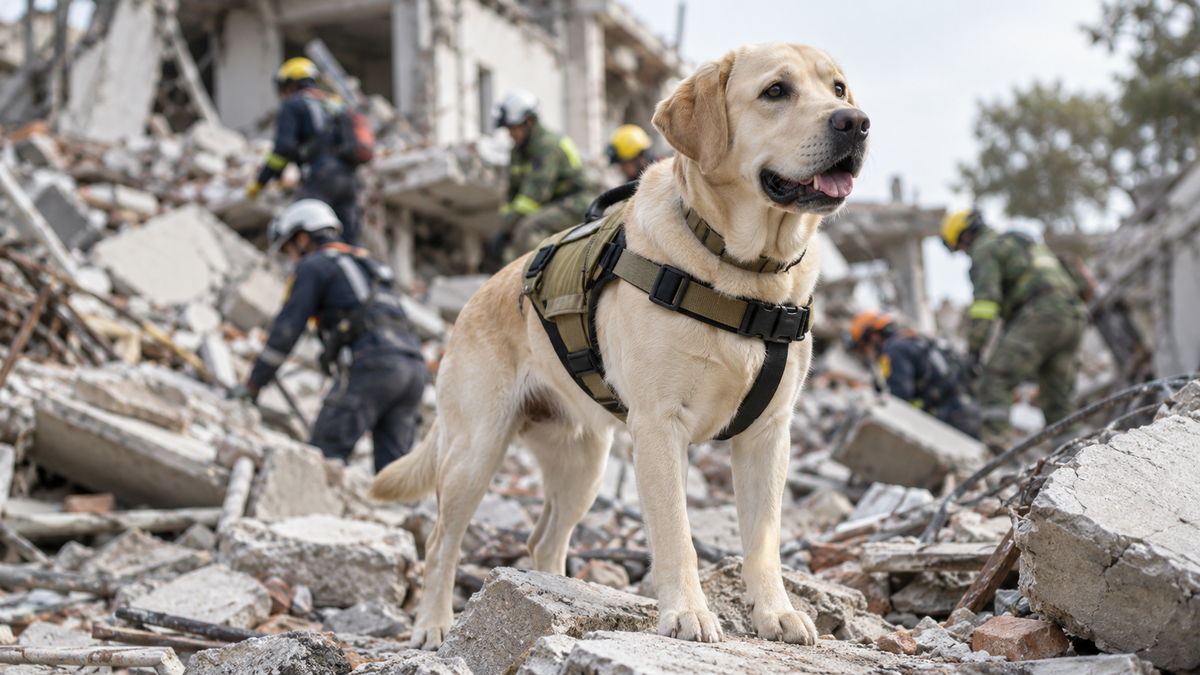
Frida wore protective goggles to shield her eyes from dust, debris, and flying particles common in collapsed structures, a harness across her back for handlers to guide and, if necessary, lift her, and small protective boots on her paws so that broken glass and jagged rubble couldn't cut her as she climbed through the wreckage of collapsed buildings. Her handler, Israel Arauz Salinas, worked alongside her on a job with a brutally simple description, however physically demanding it actually was: climb into the ruins after a disaster, and bark the moment you find someone, alive or not.
A record built disaster by disaster
Frida's career took her across multiple countries and multiple kinds of catastrophe over the years. She was sent to Haiti after its devastating 2010 earthquake, where she helped locate twelve people alive amid the ruins of Port-au-Prince and the surrounding area. From there she went to the site of a gas explosion in Mexico City, and later to a landslide in Ecuador, every time climbing into collapsed or unstable structures that no human rescuer could safely enter without significant risk.
September 19, 2017
Then came the earthquake that would come to define her public legacy. On September 19, 2017, a powerful magnitude earthquake struck central Mexico, collapsing buildings across large parts of Mexico City and the surrounding region. Hundreds of people were confirmed dead in the days that followed. Many more remained missing, buried somewhere beneath the wreckage of their own homes, schools, and offices.
Rescuers dug by hand through the debris, working in shifts around the clock. When they needed total silence to listen for faint voices or tapping sounds beneath the rubble, they raised their fists in the air as a signal, and entire city blocks fell quiet in response, holding their breath together.
Into that silence, again and again, over days of grueling work, walked a yellow Labrador in goggles and little boots.
A life worth remembering
Hope can arrive on four paws.
The face of a nation's hope
People across the city watched Frida climb into the ruins day after day, often broadcast live on national television. Mexico, as a country, turned on the news and watched her too, in a week when very little other news offered much comfort. In the worst week the capital had experienced in decades, she became something considerably larger than a single rescue dog doing her job: a visible, recognizable symbol that searching, however exhausting and however long it stretched on, was still worth continuing.
Fifty-five missions, fifty-five lives touched
Frida continued working until 2019, completing fifty-five total rescue missions over the course of her decade-long career. Across her working life, she is credited with finding fifty-five people in total, twelve of them found alive, the remainder located for their families to finally be able to grieve and bury them properly. When she died in 2022, at thirteen years old, Mexico had already erected statues in her honour in multiple locations, and her ashes were ultimately buried at the foot of one of them.
Proof that someone was still looking
When a country is reeling from disaster and beginning to lose hope that anyone else will be found alive, a single dog in little rubber boots, still methodically climbing into the rubble day after day, can mean more to the people watching than almost anything else rescue agencies can offer. Frida kept looking long after many observers might reasonably have stopped believing there was anyone left to find, and, twelve times over in Mexico City alone, she turned out to be right.
What makes Labradors so effective at this work
Search-and-rescue organizations around the world rely heavily on Labrador Retrievers for exactly the combination of traits Frida displayed throughout her career: a nose sensitive enough to detect human scent through collapsed concrete and twisted rebar, a body athletic and sturdy enough to physically navigate unstable rubble fields without excessive risk of injury, and a temperament steady enough to keep working calmly amid the noise, dust, and chaos of an active disaster site, rather than becoming overwhelmed by it. Training a dog to this level typically takes years, with search dogs like Frida certified and periodically recertified against strict national and international standards before being cleared for deployment to an actual disaster zone.
A legacy that outlived her own career
In the years following the 2017 earthquake, Frida became something close to a national mascot in Mexico, appearing on murals, in children's books, and in a wave of commemorative merchandise that raised funds for the Mexican Navy's ongoing search-and-rescue programs. Her example is widely credited with raising public awareness of, and public support for, canine search-and-rescue work more broadly across Latin America, inspiring expanded training programs in several countries in the years after her most famous deployment. For a country that experienced one of its most devastating natural disasters in living memory, she became an enduring, specific symbol of the idea that help, however exhausted, kept showing up anyway.
The strain of disaster work, and how handlers manage it
Search-and-rescue dogs working extended disaster deployments face a specific, well-documented occupational hazard that handlers must actively manage: the discouragement that can set in when a dog searches for hours without finding anyone alive, particularly in the later stages of a response when survivors are increasingly less likely to be found. Handlers are trained to periodically stage controlled "finds," briefly hiding a team member for the dog to successfully locate during a lull, specifically to maintain morale and keep the dog's search drive from flagging. Israel Arauz Salinas and other handlers who worked alongside Frida during the 2017 Mexico City response have described exactly this kind of careful psychological management as part of what allowed her to keep working effectively across a search operation that stretched on for days, long after the odds of finding additional survivors had dropped sharply.
That same emotional toll is part of why search-and-rescue organizations increasingly treat the dogs themselves, not only their handlers, as needing structured rest and decompression after a major deployment, a recognition that came relatively late in the broader history of the field, and one that Frida's own extended, decade-long career helped bring more clearly into public view.
A career that spanned very different countries and crises
Few search-and-rescue dogs are deployed across as many distinct international disasters as Frida was over the course of her career, moving between earthquake response in Haiti, an urban gas explosion, a landslide in Ecuador, and ultimately the defining earthquake of her own home country. Each of those environments presented different physical hazards and different search conditions, collapsed multi-story buildings, unstable mud and debris fields, confined industrial wreckage, and her ability to work effectively across all of them reflected both exceptional individual training and a breadth of operational experience that relatively few working dogs, in any country's search-and-rescue program, are given the opportunity to accumulate within a single career.
The Mexican Navy has continued to feature Frida's story prominently in its own recruiting and public-outreach materials for its canine search-and-rescue program in the years since her death, using her documented record as a concrete illustration of what the service's search dogs are capable of in practice, rather than relying solely on more abstract descriptions of the training and capability involved.
Remember the name
Frida at a glance
- Breed: Labrador Retriever
- Born: 2009
- Service: Mexican Navy search-and-rescue dog
- Handler: Israel Arauz Salinas
- Known for: Fifty-five rescue missions, including the 2017 Mexico City earthquake, Haiti, Ecuador and earlier Mexico City disasters
- Career total: Fifty-five people found, twelve of them alive
- Died: 2022, at thirteen years old
Further reading: Frida, Mexico's hero rescue dog, The New York Times, Frida the rescue dog dies in Mexico, BBC News
Love Frida's story? Shop the Frida Sweatshirt and bring it home.
The story stays with us
Remember Frida.
Explore the tributes inspired by Frida's story, or meet another dog whose life deserves to be remembered.