
The story behind the tribute
Gander: The Newfoundland Who Charged the Grenade
A remarkable life. A lasting bond. A story that deserves to be remembered.
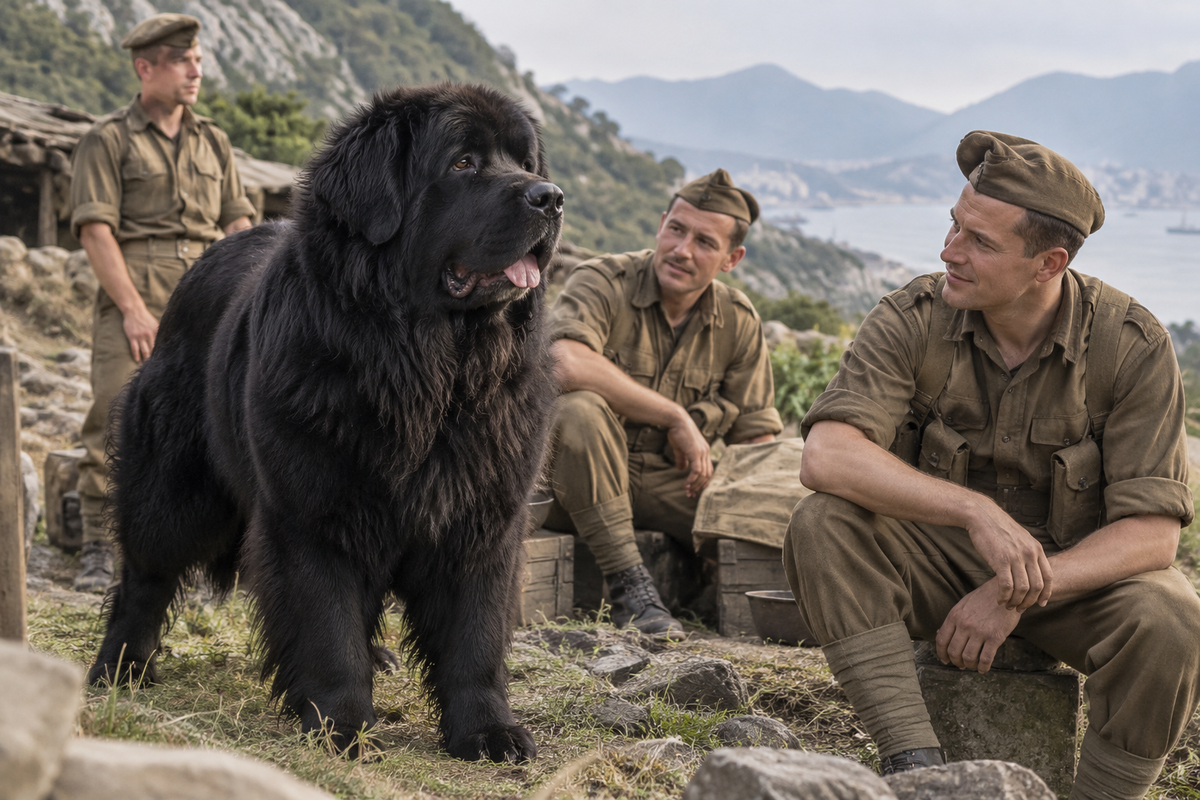
The life behind the tribute
Remember Gander.
A family gave away their enormous, gentle dog to keep a little girl safe from an accident that was never his fault. In Hong Kong, in the middle of a battle, he gave his life to keep a group of wounded soldiers safe from something far worse.This is the story of Gander, a Newfoundland who went from a fisherman's companion to a Canadian regiment's mascot to one of the most storied military dogs of the Second World War, and whose single act in December 1941 is still formally remembered decades later.
Built for cold water and hard work
The Newfoundland is a giant, gentle breed that developed on the rugged coast of Canada, bred over generations to work alongside fishermen in brutal conditions, hauling fishing nets through freezing water, and pulling drowning men to safety when boats capsized or sailors were swept overboard. The breed is known for enormous physical strength paired with an unusually gentle, patient temperament around people, particularly children. Gander, born into a family in the town of Gander, Newfoundland, and originally named Pal, grew into exactly that kind of dog: enormous, affectionate, and devoted above all to the children of the household, who he pulled around on sleds in the winter and followed everywhere he was allowed to in the summer.
An accident, and a hard decision
One day, while playing exuberantly as young, oversized dogs often do, Pal jumped up and accidentally scratched a little girl's face. It was nothing more than the clumsy, overeager excitement of a huge young dog who didn't yet know his own size or strength, but he weighed as much as a grown man, and his family, afraid of what might happen if a similar accident occurred again with more serious consequences, made the painful decision to give him away rather than risk it.
They gave him to the soldiers of the Royal Rifles of Canada, who were stationed nearby at the time. It was a decision meant purely to keep everyone safe. It also, without anyone involved intending it, placed Pal on a path that would eventually lead him into one of the most brutal battles of the Pacific theatre of the Second World War.
Gander of the Royal Rifles
The soldiers took to him immediately. They renamed him after the town he came from, Gander, and he quickly became a full, if entirely unofficial, member of the regiment. He marched alongside them in parades. He slept in their barracks. He was, by every surviving account, exactly the kind of mascot who made homesick young men a world away from their families feel a little less alone.
Sent to defend Hong Kong
In 1941, the regiment was deployed overseas to help reinforce the British defence of Hong Kong against the rapidly growing threat of war with Japan in the Pacific. Gander went with them, crossing an ocean as what had, by then, effectively become one of their own. That December, Japan launched its attack. The Canadian defenders, badly outnumbered and facing a far larger, better-equipped force, fought on regardless for days in increasingly desperate conditions.
A life worth remembering
A life remembered for the lives it protected.
The night of December 19th
On the night of December 19, 1941, a group of wounded Canadian soldiers lay together on the ground, unable to move under their own power in the middle of the fighting. Gander stood over them, growling steadily at the advancing enemy, the only defense a dog, however large, had any means of offering against armed soldiers.
Then a live grenade landed among the wounded men.
They couldn't run. They couldn't even really move. Gander did not bark, and he did not retreat to safety. Instead, he picked the live grenade up in his mouth and ran with it, directly toward the advancing enemy line, and away from the men he had positioned himself to guard.
It exploded. The soldiers he had been standing over survived. Gander did not.
Recognized decades later
Fifty-nine years after his death, in the year 2000, Gander was posthumously awarded the Dickin Medal, the highest honour an animal can receive for gallantry in the service of war, sometimes described informally as the animal world's Victoria Cross. The citation specifically recognized his repeated acts of protecting Canadian soldiers during the Battle of Hong Kong, of which carrying the grenade was the final and most decisive. Today his name is carved into the Hong Kong Veterans Memorial Wall in Ottawa, alongside the names of the Canadian soldiers who died defending the colony, the same men whose fight he had shared, in every practical sense, right up to the very end.
Given away to keep one girl safe
There is a particular, almost unbearable symmetry to Gander's story: a family gave him up specifically to protect a child from an accident born of nothing more than clumsy, overgrown affection, and in doing so set him unknowingly on the road to a war where he would ultimately give everything he had to protect soldiers who had, by then, become his new family in every sense that mattered to him. He never really stopped being the dog who instinctively put himself between danger and the people he loved. On December 19, 1941, he simply ran out of smaller ways left to prove it, and chose the only one that remained.
The Battle of Hong Kong, briefly
The defence of Hong Kong in December 1941 was, by most historical assessments, a largely hopeless undertaking from the outset. The combined garrison of British, Canadian, and local volunteer forces numbered a few thousand, facing a far larger and better-prepared Japanese invasion force. The Canadian contingent, including the Royal Rifles that Gander belonged to, had only arrived in the colony weeks earlier and had little time to acclimatize or prepare defensive positions before the attack began. Fighting continued for roughly seventeen days before the garrison was finally forced to surrender on Christmas Day, 1941. Many of the Canadian soldiers who survived the battle itself went on to endure years of brutal captivity in Japanese prisoner-of-war camps, and a significant number did not survive the war at all.
A mascot's name carried forward
Gander's story might easily have been lost entirely, as so many individual acts of wartime bravery were, buried within a battle that ended in defeat rather than victory and therefore received comparatively little attention in the decades immediately following the war. It survived in regimental memory and in the accounts of surviving soldiers, and was eventually formalized through the Dickin Medal nomination process, decades after the fact, once advocates pieced together enough surviving testimony to support a formal citation. Today, Gander is one of relatively few Second World War animals honoured specifically for actions taken in a battle that ended in surrender rather than triumph, a reminder that the medal has always recognized individual acts of courage rather than the ultimate outcome of the wider campaign around them.
A story pieced together from survivors
Because so many of the Canadian soldiers who witnessed Gander's actions that night were themselves killed, wounded, or taken prisoner in the fighting that followed, the full account of what happened on December 19, 1941, relies heavily on the testimony of a relatively small number of survivors who were later able to describe it. Several of those survivors spent the remainder of the war in Japanese prisoner-of-war camps under extremely harsh conditions before being repatriated at the war's end, and it was largely through their later accounts, given years after the fact, that Gander's actions were eventually documented in enough detail to support a formal honour. The gap between the event itself and its wider public recognition, spanning nearly six decades, reflects just how easily this kind of story might never have reached a wider audience at all, had those particular men not survived to tell it.
A memorial shared with the men he served beside
The Hong Kong Veterans Memorial Wall in Ottawa, where Gander's name is now carved, was erected specifically to honour the roughly two thousand Canadian soldiers who took part in the defence of Hong Kong, nearly three hundred of whom died in the fighting or in the brutal years of Japanese captivity that followed for the survivors. Gander's inclusion on that wall places him, deliberately and formally, among the human soldiers he served alongside rather than in a separate category reserved for animal mascots, a distinction that veterans' families involved in the memorial's planning specifically advocated for, arguing that his final act made him, in every meaningful sense that mattered to the men he saved, one of their own.
Remember the name
Gander at a glance
- Breed: Newfoundland
- Original name: Pal
- Home: Gander, Newfoundland, Canada; later mascot of the Royal Rifles of Canada
- Known for: Carrying a live grenade away from a group of wounded soldiers during the Battle of Hong Kong, December 19, 1941
- Honor: Dickin Medal, awarded posthumously in 2000
- Legacy: Named on the Hong Kong Veterans Memorial Wall in Ottawa
Further reading: Gander, PDSA Dickin Medal citation, Gander, the dog hero of Hong Kong, CBC News
Love Gander's story? Shop the Gander Sweatshirt and bring it home.
The story stays with us
Remember Gander.
Explore the tributes inspired by Gander's story, or meet another dog whose life deserves to be remembered.