
The story behind the tribute
Greyfriars Bobby: Edinburgh’s Faithful Dog, and a Story Still Debated
A remarkable life. A lasting bond. A story that deserves to be remembered.
The life behind the tribute
Remember Greyfriars Bobby.
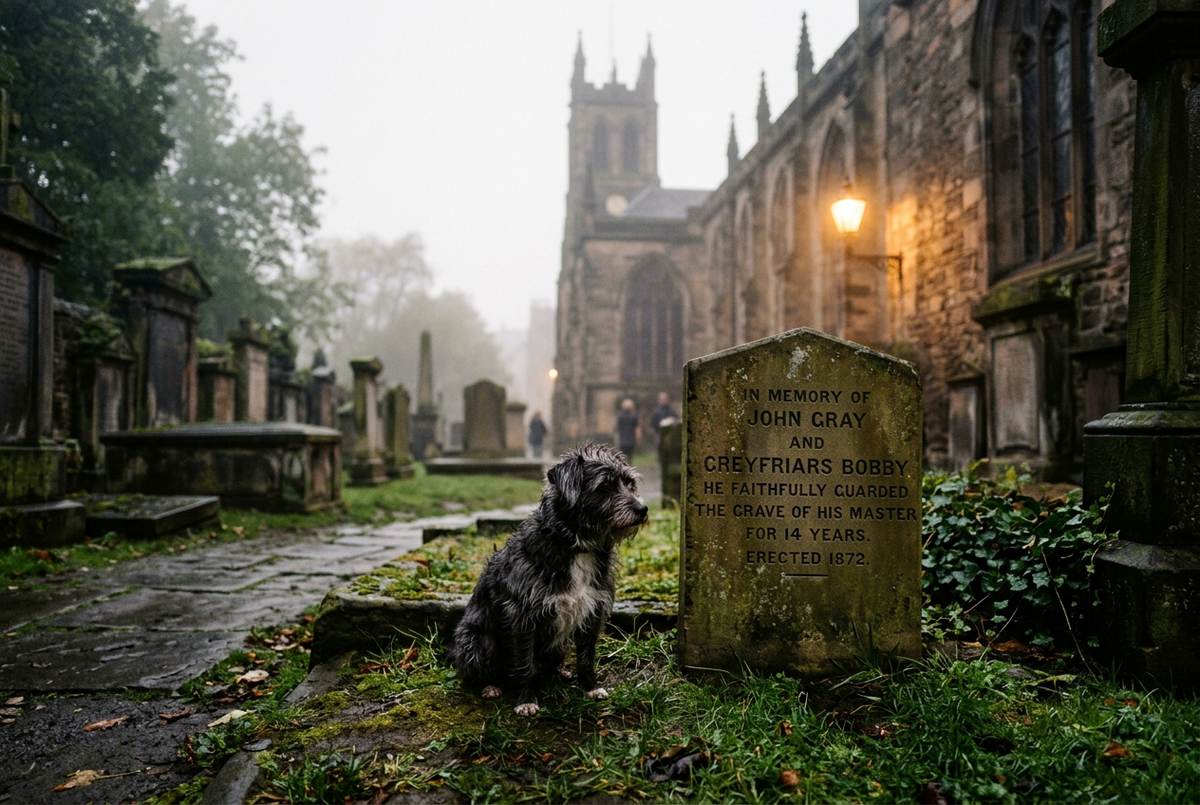
In Edinburgh’s Old Town, a small dog became the centre of one of the city’s best-known stories. Greyfriars Bobby is said to have kept watch by his owner’s grave for fourteen years. The tale is beloved, but historians and local records leave important questions open.
A story rooted in Edinburgh
Greyfriars Kirkyard lies beside Greyfriars Kirk in the heart of Edinburgh’s Old Town. Its stones and paths hold centuries of the city’s history. Visitors come for the architecture, the graves, and the stories that gather around the place. One of the most famous is about a small dog called Bobby, whose name became associated with loyalty and mourning.
The traditional story connects Bobby to John Gray, a night watchman with Edinburgh City Police. Gray died in 1858 and was buried in Greyfriars Kirkyard. According to the legend, Bobby returned to the grave and stayed near it for years. Residents and visitors came to know the dog, and people in the neighborhood gave him food and shelter. The familiar version says he remained there until his own death in 1872.
It is a story with a clear shape: a man dies, a dog refuses to leave, and a community witnesses the devotion. That shape has made Bobby easy to remember and retell. Yet the historical record is not as simple as the popular version. Even the question of who Bobby belonged to has been debated. Edinburgh’s own museum collections describe his origins as unclear and note that the identity of his owner is disputed.
The first public accounts
Bobby’s story entered public print during his own lifetime. In 1867, a newspaper account described the dog’s presence in Greyfriars and the questions surrounding his ownership. At the time, dog licensing rules mattered. If no one claimed Bobby, local authorities could treat him as an unlicensed animal. The dog’s growing fame brought him to the attention of public figures, including Lord Provost William Chambers, who paid for his license and gave him a collar.
The collar, now held by the Museum of Edinburgh, is a tangible object connected with the legend. It tells us that Bobby was recognized as a real dog in the city and that officials took steps to protect him. It does not, by itself, settle every detail of the story. A collar can confirm that a dog existed and was cared for; it cannot prove that he spent every night beside one specific grave for fourteen years.
Accounts from the period portray Bobby as a familiar presence around the kirkyard and nearby streets. Edinburgh’s Capital Collections notes that he was fed and sheltered by local residents, and that he also visited a nearby restaurant. He was a living animal moving through a neighborhood, not a statue frozen in a pose. The public image of the dog at the grave may compress a more varied daily life into one memorable scene.
Which John Gray?
The traditional owner is John Gray, a police watchman. But later writers proposed that Bobby may have belonged to another John Gray, a shepherd known as Auld Jock. Edinburgh’s Capital Collections summarizes this alternative, which was advanced by Eleanor Atkinson in a book published in 1912. The shepherd was also in Edinburgh around the time of his death, though he was buried elsewhere. The existence of competing accounts is one reason historians continue to question whether the popular story identifies Bobby’s owner correctly.
These debates are not merely academic. The relationship between the dog and the person named in the story is the emotional core of the legend. If the owner’s identity is uncertain, then the precise story of the grave vigil becomes uncertain too. That does not prove the tale is false. It means the evidence does not support presenting every detail as settled fact.
Some scholars have also questioned how a small dog could have spent so many years in the kirkyard and whether the famous account was shaped by nineteenth-century storytelling and later popular culture. The answer is not a neat verdict. Contemporary records establish that a dog called Bobby became known in Edinburgh and was connected to Greyfriars. The most detailed sentimental version developed over time. We should distinguish what the records support from what later retellings add.
The daily life behind the legend
The image of Bobby at a grave is powerful, but it may not describe every hour of his life. Edinburgh’s Our Town Stories account says he spent much of his time moving around the neighborhood, seeking food and visiting familiar places. It also describes how a local caretaker and residents looked after him. If this account reflects the daily reality, Bobby’s existence was not one uninterrupted vigil. He was part of a community, with a circuit of places and people.
That detail does not diminish the story. It makes it more human and more historically plausible. A dog who was cared for by several people could have formed attachments to a place and a routine while still eating, resting, and exploring elsewhere. The popular narrative simplifies the pattern into a single act of loyalty. The fuller picture includes neighbors who made space for an animal that might otherwise have been treated as a stray.
One account says Bobby learned to associate Edinburgh Castle’s One o’clock Gun with his meal time and would leave the kirkyard for food. This detail has circulated in local histories and suggests that the dog’s life involved regular contact with the city’s rhythms. The sound of the gun, the restaurant, the cemetery, and the people around him formed the setting in which the legend grew. Each place gave witnesses another reason to remember him.
A life worth remembering
A story remembered with love, and told with care.
A statue, a fountain, and a memorial
Bobby died in 1872. The following year, a drinking fountain topped with a statue of the dog was unveiled near the entrance to Greyfriars Kirkyard. The memorial was commissioned by the philanthropist Baroness Burdett-Coutts and sculpted by William Brodie. It transformed Bobby from a neighborhood dog into a permanent figure in Edinburgh’s public landscape.
The statue was originally part of a fountain, with a basin for people and one for dogs. Its placement near the kirkyard made the connection between dog and grave visible to anyone passing through the Old Town. A separate memorial for Bobby was later placed near the kirkyard entrance, while his reputed grave is marked near the gate. The city’s memorial landscape tells the story of how memory accumulates: first a reported dog, then a statue, later additional markers and museum objects.
The statue has attracted visitors for generations. Some rub its nose for luck, though that custom is relatively recent and has caused wear to the bronze. The act is another layer in Bobby’s public afterlife. Visitors who touch the statue become part of the story, even if they know only the simplest version. The monument is not just a record of the nineteenth century; it is an object people continue to use and reinterpret.
Why the story lasted
Greyfriars Bobby became famous because the tale gave people a way to speak about grief and loyalty. In a crowded city, the image of a dog returning to one grave is direct and intimate. It suggests that love persists after death, and that an animal may keep a bond alive even when the human world has changed. Victorian readers were drawn to stories of faithful animals, and Bobby’s legend fit that cultural appetite.
As the story crossed into books, illustrations, and films, each retelling could strengthen the image of the dog at the grave. Some versions added dramatic scenes or simplified the identity dispute. Popular culture helped Bobby become known far beyond Edinburgh, but it also made the tradition feel more certain than the historical record allows. Repetition can turn a claim into common knowledge without adding new evidence.
Still, it would be too simple to say that because there is uncertainty, nothing meaningful happened. Bobby was real. People noticed and cared for him. A public story about his attachment to a grave emerged while he was alive, and his memory became important enough for a statue and lasting civic attention. The precise details remain debatable, but the story’s social history is well documented.
What devotion can mean
We cannot know what Bobby thought as he moved through Greyfriars or whether he understood the grave as the resting place of a person he loved. People observed his behavior and interpreted it through their own ideas of fidelity and mourning. That interpretation became the story. It is possible to respect the emotional meaning while being honest about the limits of what can be known.
Dogs form attachments, remember places, and respond to familiar routines. They can continue to seek people or places associated with safety and care. But a human story about grief should not be placed directly inside a dog’s mind as if we had access to it. Bobby’s behavior was visible; his inner experience remains beyond the historical record. The legend bridges that gap with feeling, but a fact-checked telling should show where the bridge begins.
The strongest version of the story may be the one that holds uncertainty openly. A dog was known in Edinburgh as Bobby. He was connected to Greyfriars and cared for by local residents. People told a story that he remained devoted to a dead owner. Questions about the owner’s identity and the exact nature of the vigil persist. The city remembered him anyway.
Walking past Bobby today
Visitors now encounter Bobby in several forms: the bronze dog on the fountain, the collar in the museum, the grave markers, and the books that retell his history. Each offers a different kind of evidence. The collar points to a real animal and public care. The statue points to the power of the story. The archives and local historical accounts show how the narrative developed and where its uncertainties remain.
Greyfriars itself asks people to move through the past carefully. The kirkyard is a place of burial, not simply a stage for a charming anecdote. Bobby’s story draws attention to the human and animal lives associated with it, but it should not obscure the many others remembered there. The dog belongs to a much larger Edinburgh history, one shaped by memory, tourism, community, and the stories people choose to preserve.
It is understandable that people want the legend to be true exactly as they have heard it. The image is beautiful. But uncertainty does not take away Bobby’s place in the city. It gives us a reason to tell his story as a story with layers: a dog and a grave, witnesses and caretakers, a collar and a statue, competing accounts, and generations of readers who found meaning in a dog’s persistence.
Historical note
Greyfriars Bobby was a real dog known in nineteenth-century Edinburgh and connected with Greyfriars Kirkyard. The traditional account links him to police watchman John Gray and says he remained by Gray’s grave for fourteen years. The owner’s identity and details of the vigil have been debated. See Edinburgh’s Capital Collections, Our Town Stories, and the Wikipedia overview.
Love Greyfriars Bobby's story? Shop the Greyfriars Bobby Sweatshirt and bring it home.
The story stays with us
Remember Greyfriars Bobby.
Explore the tributes inspired by Greyfriars Bobby's story, or meet another dog whose life deserves to be remembered.