
The story behind the tribute
Judy: The Pointer Who Became a Prisoner of War
A remarkable life. A lasting bond. A story that deserves to be remembered.
The life behind the tribute
Remember Judy.
A dog among the ships
There was no grand plan for the puppy. She was a mascot, a living presence aboard a working ship. Sailors gave her food, attention and a place in the daily life of the vessel. Judy grew up around decks, engines, riverbanks and the human rhythms of a crew that moved from port to port. Those who later remembered her described a dog who could hear aircraft approaching and bark an alarm. It was an early warning that mattered in a region where war was drawing closer.
In 1939, sailors from HMS Gnat moved to another gunboat, HMS Grasshopper, and Judy went with them. The move carried her into a far larger danger. Japan's entry into the war in December 1941 brought the conflict to the waters around Malaya and Singapore. By early 1942, British and Allied forces were retreating south as Japanese troops advanced. Grasshopper took part in evacuations from Malaya toward Singapore, then tried to escape as Singapore itself faced capture.
The crew did not know that the ordinary shipboard world they had made with Judy was about to vanish.
The island with no water
In February 1942, Japanese aircraft attacked HMS Grasshopper as it sailed away from Singapore. The ship was badly damaged, and the order came to abandon her. Men entered the water and made for land. Judy was missing.
A sailor went back aboard and searched below deck. Judy had become trapped inside the stricken ship. He found her and carried her out. Accounts differ in some details of the escape, but the central fact is clear: Judy and the surviving crew reached a small, uninhabited island with no dependable supply of fresh water.
The island offered no shelter from the tropical heat and no easy way to call for help. The crew had survived the bombing and the sinking, only to face thirst. Salt water could not save them. Each hour made the need more urgent.
Then Judy began digging in the sand.
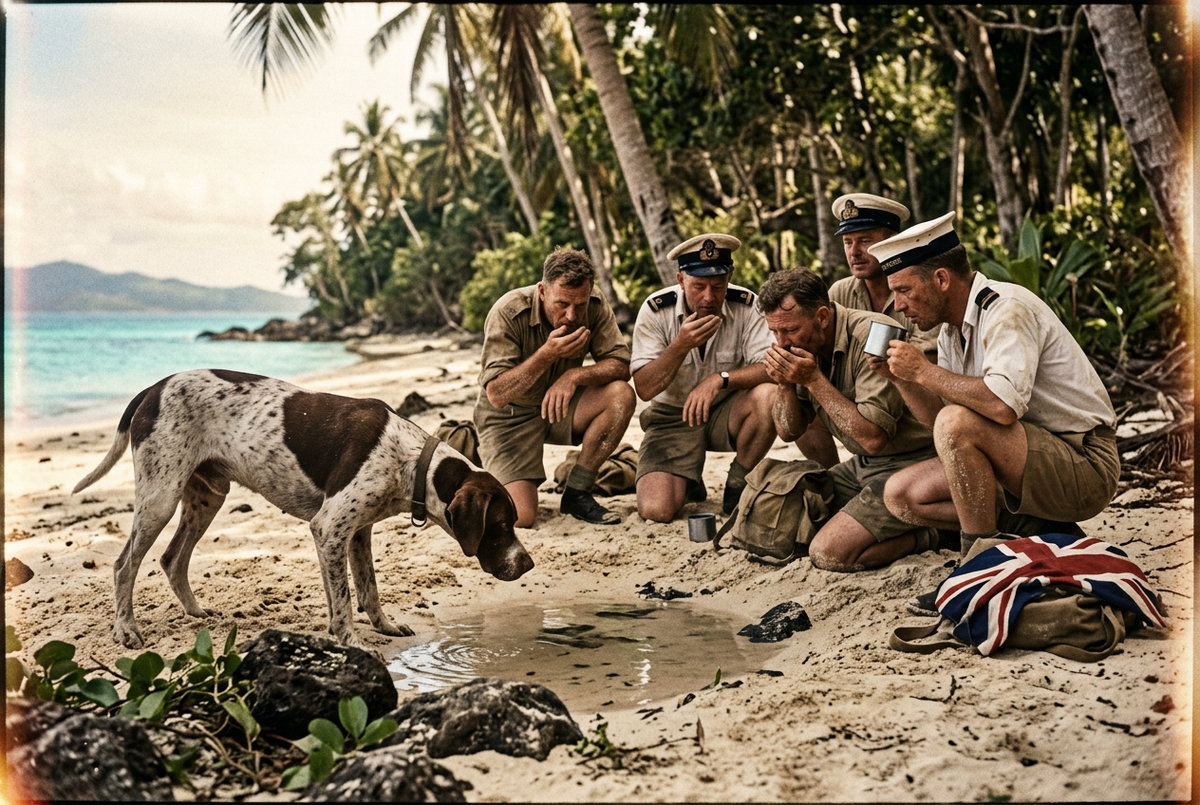
She worked at a patch of ground until water appeared. It was a spring, a small source of fresh water that gave the stranded sailors something they could drink. The PDSA's account and the later National Archives history both record that Judy found the spring. It is one of the most striking episodes in her life, but it should be told plainly. Judy did not magically rescue an entire ship by herself. She helped a group of survivors find water at a moment when it was desperately needed.
The men were eventually taken from the island and continued their attempt to reach Allied forces. They crossed to Sumatra, in the Dutch East Indies, now Indonesia. But the military situation had collapsed around them. British forces had surrendered in Singapore, and the surviving Grasshopper crew were captured by Japanese forces in March 1942.
They were prisoners of war. Judy was taken with them.
The number 81A
Judy entered Gloegoer camp near Medan on Sumatra with men who had already lost their ship, their freedom and any certainty about what would happen next. A dog in a prison camp was a liability. Food was scarce, and guards could punish or kill an animal that attracted attention. Judy was at risk simply because she was there.
In August 1942, she met Frank Williams, a British airman held at the camp. Williams shared his small rice ration with her. The gesture was modest, but in a place where hunger pressed on every decision, it mattered. Judy stayed close to him. Williams began to protect her, and he later described her as a companion whose presence helped the prisoners endure captivity.
The camp's guards could have treated Judy as an unwanted animal. Instead, Williams persuaded the authorities to register her. Judy was assigned the number 81A Gloegoer Medan. The National Archives describes her as the only dog known to have been officially registered as a British prisoner of war during the Second World War. Her number gave her a formal place in the camp records and helped secure food for her.
It is easy to let the novelty of a dog with a prisoner number overshadow the human reality of the camp. Judy was living among men subjected to forced labour, hunger, sickness and violence. She could not change the conditions around them. Her value was more immediate. She offered company, routine and something familiar in a world designed to strip those things away.
The surviving accounts say she warned prisoners of danger, alerted them to snakes and other threats, and sometimes distracted guards when men were being beaten. Stories of animal courage can grow brighter in the retelling, so the record matters here. Judy's Dickin Medal citation later praised her endurance, her contribution to morale and her watchfulness in saving lives. The official citation does not turn every camp story into a verifiable incident, but it does show what those who honoured her believed her presence had meant.
Williams and Judy became inseparable. He had found a friend in a place where friendship itself was difficult to preserve.
A voyage that became another disaster
In June 1944, prisoners from Medan were moved by sea toward Singapore. Dogs were not supposed to travel with them. Williams hid Judy in a sack of rice and got her aboard the transport ship, the SS Van Warwyck. It was a dangerous act. If she had been discovered, she could have been taken from him or killed. If she had been left behind, he might never see her again.
The ship was attacked and sank. Prisoners were thrown into the sea amid wreckage, confusion and the struggle to stay afloat. Judy survived. PDSA's account says she pushed pieces of driftwood toward prisoners who could not swim. That detail appears in the institutional history of her medal and is part of the story that accompanied her award. What can be said without embellishment is that she survived the sinking alongside the men who had shared her captivity.
When survivors reached land, Judy faced a new threat. A dog among prisoners was still not safe. The former camp commander, who had grown fond of her, declared her an official prisoner of war. The number 81A followed her beyond the camp. It helped spare her life and marked an unusual fact of wartime history: a dog had been registered as a prisoner among British servicemen in Japanese custody.
A life worth remembering
Companionship can endure the hardest days.
Survival, separation and the journey home
Judy and Williams endured several more moves between camps. She suffered injuries and illness, and the details recorded in later accounts include a wound from an alligator bite during the earlier escape through Sumatra. By the time Japan surrendered in August 1945, Judy had survived nearly three and a half years of captivity.
Freedom did not immediately mean home. Williams arranged for Judy to travel back to Britain, concealing her aboard the troopship Antenor. The voyage took weeks. When they arrived, Judy was placed in quarantine, as required for animals entering Britain. For six months, she lived apart from Williams in kennels. He visited her while he could. After years in which they had shared food, danger and confinement, the separation was a final test of patience.
When quarantine ended, Judy and Williams were reunited. The dog who had travelled across oceans and camps was home with the airman who had shared his ration with her. Their story drew attention in Britain, where the public learned about the ship's mascot who had become a prisoner of war.
On May 2, 1946, Judy received the PDSA Dickin Medal. The award citation recognised her courage and endurance in Japanese prison camps, her role in maintaining the prisoners' morale, and the lives she helped save through intelligence and watchfulness. The medal is often called the animals' Victoria Cross, though it is a distinct award created by the PDSA to honour animals serving in wartime.
Judy's medal did not make the suffering of captivity smaller, nor could it repay the people who did not survive. It gave public recognition to a dog whose story had been recorded in the lives of the men around her. It also made visible the part animals played in war: as companions, mascots, working partners and sources of steadiness in circumstances that were anything but steady.
The life that followed
Judy and Williams remained together after the war. He later took work in East Africa, and Judy went with him to what is now Tanzania. After so many years defined by ships, camps and movement, she had a quieter life beside the man who had protected her. Frank built a memorial at her grave after she died on February 17, 1950.
Judy's story is sometimes reduced to a sequence of astonishing rescues: the ship, the spring, the prisoner number, the sinking transport and the medal. The facts are remarkable enough. Yet the thread running through them is smaller and more human. A crew made room for a puppy. A sailor went back into a damaged ship to find her. A hungry airman shared his rice. A prisoner argued that the dog beside him should be counted and fed. A man carried her home after the war and kept her there.
Judy could not understand the armies, borders and orders that moved her through the war. She could understand the people near her. She stayed with them, and they chose to keep her with them. That mutual loyalty is why her story has endured beyond the official number entered in a camp register.
The spring she found on a bare island offered water when the sailors had none. The number 81A offered protection in a place where she had no legal standing of her own. The medal recognized the courage and companionship the prisoners remembered. None of these things turned war into a storybook. They show how one dog's presence could make survival a little less lonely.
Judy was born a ship's mascot. She became a prisoner of war, a medal recipient and, for Frank Williams, a lifelong companion. Her story belongs to the history of the Second World War, but its heart is found in one shared ration and one friendship that lasted after the ships fell silent.
Remember the name
Judy at a glance
- Born: February 1936, Shanghai, China
- Breed: Liver-and-white English Pointer
- Served aboard: HMS Gnat, then HMS Grasshopper
- Prisoner number: 81A Gloegoer Medan, Sumatra
- Companion: Frank Williams, RAF airman
- Honour: PDSA Dickin Medal, awarded May 2, 1946
- Died: February 17, 1950, East Africa (now Tanzania)
Further reading: Judy (dog), Wikipedia, Judy, The National Archives, Judy, PDSA Dickin Medal, Judy: The Dog Who Became a Prisoner of War, GOV.UK
Love Judy's story? Shop the Judy Sweatshirt and bring it home.
The story stays with us
Remember Judy.
Explore the tributes inspired by Judy's story, or meet another dog whose life deserves to be remembered.