
The story behind the tribute
Kuno: The Dog Who Stormed a Taliban Stronghold
A remarkable life. A lasting bond. A story that deserves to be remembered.
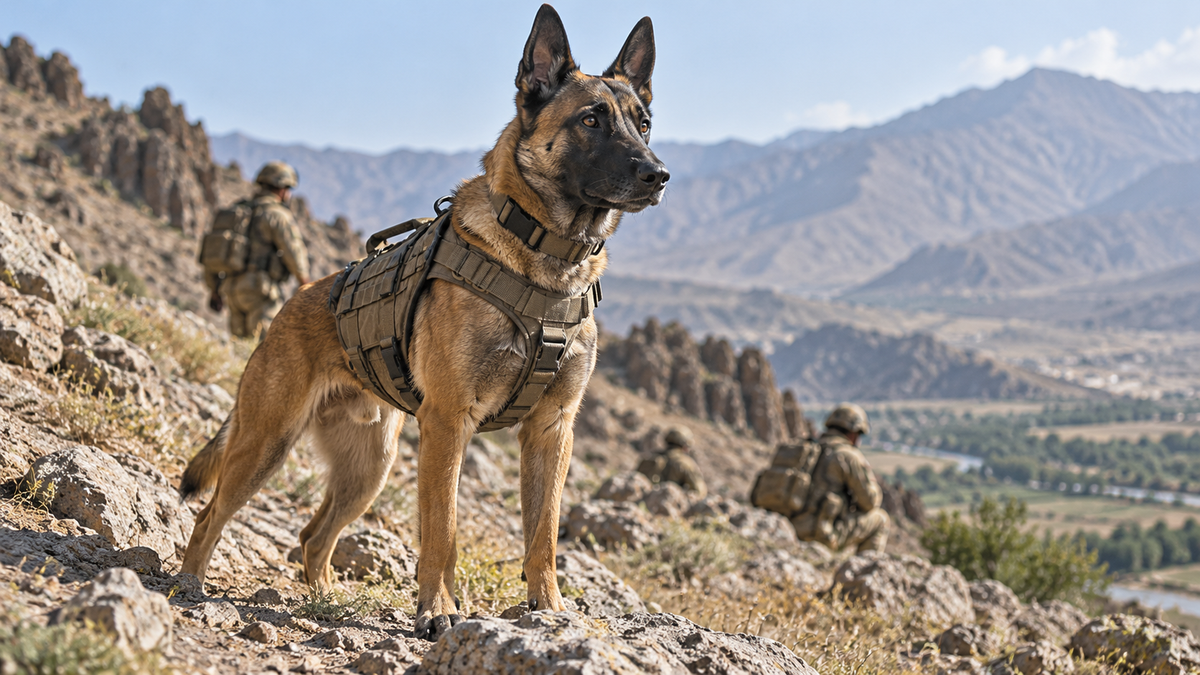
The life behind the tribute
Remember Kuno.
Shot through both back legs, he refused to let go of an armed fighter until the soldiers behind him could move in safely. The men he saved can never be named. So the world learned his name instead.This is the story of Kuno, a Belgian Malinois who served with Britain's Special Boat Service in Afghanistan, and whose actions during a single night raid turned a battle in favour of the soldiers he worked beside, a story that only became public years after it actually happened.
A breed trusted with the most demanding missions
The Belgian Malinois began as a Belgian sheep-herding breed in the nineteenth century, but over recent decades modern special forces units around the world have come to trust it above almost any other breed for the most demanding and physically dangerous missions, prizing its combination of speed, bite strength, intelligence, and sheer determination under pressure. Kuno, about four years old at the time of his most famous mission, served with Britain's Special Boat Service, an elite maritime special forces unit whose operations, and whose individual soldiers' identities, remain officially classified to this day and are likely to stay that way indefinitely.
A raid that has become public record
The soldiers Kuno served alongside during his deployment remain secret, by the deliberate and enduring nature of the unit they belonged to. Their names have never been made public, and almost certainly never will be, for reasons of ongoing operational security. But what Kuno specifically did on one particular night, years ago now, has eventually become a matter of public record, confirmed through official military honours.
2019: a compound raid under fire
In 2019, Kuno's team conducted a raid on a compound linked to al-Qaeda. The team landed in complete darkness and came under immediate, heavy machine-gun fire from defenders inside. Kuno's handler released him from his lead to engage the threat directly.
Kuno ran straight toward the source of the gunfire and successfully stopped one gunman from continuing to fire. Rather than stopping there, he then kept moving, searching methodically through the rest of the compound and locating a cache of hidden explosives that the team would otherwise have had to search for manually, at considerable additional risk. But the engagement itself was far from over.
Pinned down, with no way to move
Grenades began landing in and around the team's position. More sustained machine-gun fire followed close behind. A separate fighter, equipped with night-vision equipment that gave him a significant advantage in the darkness, had the soldiers effectively pinned down and unable to move without risking serious casualties.
Kuno's handler, assessing the situation, gave the order. Kuno charged directly toward the remaining threat.
A life worth remembering
Courage is remembered in the lives it touches.
Shot twice, and still finishing the job
The fighter fired blindly into the darkness as Kuno closed the distance between them at speed. Kuno did not stop or slow down. He reached the man, bit down firmly on his arm, and physically wrestled him to the ground, and, despite being wounded in the process, held him pinned there until the rest of the team could move in and secure full control of the situation.
That moment was, by all later accounts, the point at which the entire engagement decisively turned in the team's favour. Kuno had been shot in both of his back legs during the exchange. One bullet passed directly through his right thigh, missing a major artery by what was later described as only a fraction of an inch. A second bullet tore through his left front paw.
Flown home, and learning to walk again
American military veterinarians attached to the broader coalition treated Kuno in the field immediately after the raid and succeeded in keeping him alive, though surgeons were ultimately unable to save the damaged paw itself. He was flown back to the United Kingdom for extended treatment and rehabilitation, where he gradually learned to walk again using a custom-made prosthetic paw paired with a supportive brace on his other injured leg.
Kuno went on to become the first UK military working dog ever to be fitted with custom-made prosthetics of this kind, a milestone in veterinary care for working dogs. In 2020, in formal recognition of his actions that night, he received the Dickin Medal, the animal world's equivalent of the Victoria Cross, and one of the highest honours an animal can receive anywhere.
Then he retired
Following his recovery and rehabilitation, Kuno formally retired from active military service. The soldiers whose lives he directly helped save during that single raid can never publicly tell the world their own names, by the very secretive nature of the elite unit they served within.
So, in the years since, the world learned his name instead, a rare, publicly celebrated figure emerging from an otherwise entirely classified operation.
The particular secrecy of special forces working dogs
Dogs assigned to special forces units like the Special Boat Service operate under a level of secrecy that extends even further than that of conventional military working dogs, with details of individual operations, unit compositions, and often even a dog's specific handler typically withheld from public release indefinitely, well beyond the kind of after-action reporting that applies to most other military engagements. Kuno's case is unusual precisely because enough detail was eventually cleared for public release to support a Dickin Medal citation, a process that reportedly required careful review to ensure nothing in the account could compromise operational security or the safety of personnel still serving, even years after the raid itself took place.
A rare public face for an entirely private unit
Because so little about the Special Boat Service and its operations is ever made public, Kuno's Dickin Medal ceremony in 2020 drew considerable attention specifically as one of the only occasions in recent memory where any detail at all of a confirmed SBS operation was shared with a general audience, even in the carefully limited and sanitized form the citation took. Commentators covering the award at the time noted the unusual position this placed Kuno in: a decorated, publicly celebrated hero representing an entire unit, and an entire category of soldiers, whose own individual acts of courage that night, and on countless other missions before and since, will likely never be told in any comparable detail.
Prosthetic care for military working dogs
Custom prosthetics for working dogs remain a relatively specialized and technically demanding area of veterinary medicine, requiring careful, repeated fitting to accommodate a dog's changing gait and weight distribution as he adapts to a new limb over a period of months. Kuno's rehabilitation involved both the prosthetic paw itself and an extended course of physical therapy to rebuild strength and confidence in his remaining limbs, a process his veterinary team described as requiring much the same patience and incremental progress seen in human amputee rehabilitation programs. His successful adaptation has since been referenced by veterinary researchers studying prosthetic design for working and military dogs more broadly, as an example of a complex case achieving a genuinely functional, pain-free outcome rather than a merely cosmetic one.
A name chosen to be remembered
Military working dogs deployed with special forces units are sometimes given deliberately unremarkable names specifically to avoid drawing attention in operational reporting, which makes it notable that "Kuno" has become, since his Dickin Medal ceremony, a name specifically and publicly associated with one of the most secretive branches of the British armed forces. His award ceremony, held with careful attention to what could and could not be disclosed, has since become something of a rare touchstone for public discussion of special forces working-dog programs more broadly, a subject about which almost nothing else is typically shared outside the Ministry of Defence's own closed channels.
A reminder of the risk still carried today
Kuno's injuries, sustained during a 2019 operation, are a reminder that military working dogs attached to active special forces units continue to face combat risks comparable to those borne by the human soldiers they serve alongside, even as the broader public conversation about recent conflicts has moved on in the years since. His recovery and subsequent retirement were treated, within the limited material the Ministry of Defence released, with the same formal care typically extended to a human service member's medical discharge, a detail that observers of military working-dog policy have noted as part of a slow, ongoing shift toward treating these animals' service, and its costs, with comparable institutional seriousness.
Remember the name
Kuno at a glance
- Breed: Belgian Malinois
- Service: Britain's Special Boat Service, Afghanistan
- Known for: Subduing an armed fighter under direct gunfire during a 2019 compound raid, turning the course of the battle, despite being shot in both back legs
- Injury: Lost use of his left paw; fitted with the first custom-made prosthetic paw given to a UK military working dog
- Honor: Dickin Medal, awarded 2020
- Status: Retired from active service after his recovery
Further reading: Kuno, PDSA Dickin Medal citation, Kuno: UK special forces dog awarded Dickin Medal, BBC News
Love Kuno's story? Shop the Kuno Sweatshirt and bring it home.
The story stays with us
Remember Kuno.
Explore the tributes inspired by Kuno's story, or meet another dog whose life deserves to be remembered.