
The story behind the tribute
Laika: The Little Dog Who Reached Orbit
A remarkable life. A lasting bond. A story that deserves to be remembered.
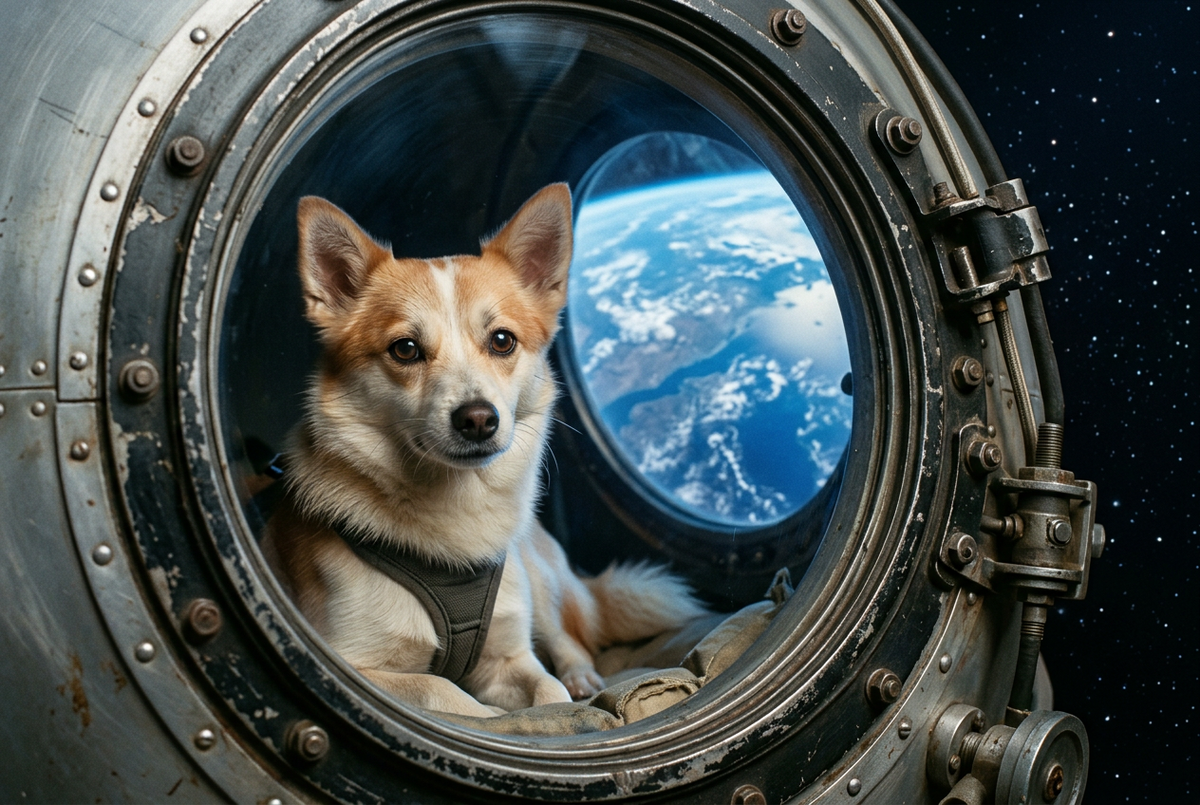
The life behind the tribute
Remember Laika.
Before people crossed the threshold of space, a small Moscow dog made the first orbit around Earth. Her flight opened a new chapter in human history, but Laika could not come home.
A city dog in a changing world
Laika’s story began far from a launchpad. She was a stray in Moscow, one of the many dogs that learned to survive in a city of trams, courtyards, crowded streets, and hard winters. Later accounts describe her as small, female, and mixed breed, perhaps with traits associated with huskies or terriers. Her original name is generally given as Kudryavka, meaning “Little Curly.” The name Laika, which can refer to a type of bark and to a group of northern hunting dogs, became the one known around the world.
In the 1950s, Soviet engineers were building rockets in a contest that was scientific, political, and deeply public. The launch of Sputnik 1 in October 1957 had sent the first artificial satellite into orbit. Its beeping radio signal crossed borders and announced that the Soviet Union had reached space first. The achievement was celebrated at home and watched anxiously abroad. It also created pressure to follow the satellite with another striking demonstration.
Scientists had begun researching how living bodies might respond to flight. Before sending a person, they needed information about acceleration, vibration, confinement, and the strange conditions beyond the atmosphere. Dogs were chosen for Soviet tests because they could be trained to remain in compact capsules and were small enough to fit into the equipment then available. Many were strays, selected in part because researchers believed animals used to harsh urban conditions might be resilient. That choice reflected the limits and moral assumptions of the era, not any ability of a dog to understand the mission that would be asked of her.
Training for an impossible journey
Laika was taken into a program where ordinary routines became preparation. Researchers introduced her to confined spaces, handling, noise, and the equipment that would monitor her body. A dog could not be told why a harness had to be worn or why movement was restricted. She could only encounter each new condition in turn and respond to the people around her. Accounts of the program describe gradual adaptation, but they also make clear that the training was demanding and the machines were unfamiliar.
Spaceflight in 1957 was still experimental. The first satellites had shown that a payload could orbit Earth, but engineers had not yet developed a reliable system to bring a living passenger back. Sputnik 2 was assembled on a rapid schedule after Sputnik 1, and its design did not include a return capsule. The plan was therefore not a round trip. Laika’s survival was not expected beyond the limited life of the spacecraft’s systems. This fact is central to her story. Her flight was a scientific first, but it was also a one-way experiment.
Those who worked with Laika later described her as gentle and cooperative. Such recollections are human memories rather than a window into her private thoughts. They tell us how people remembered her temperament; they cannot tell us what she understood about the capsule or the sky. A careful account leaves that mystery intact. We can say that she was handled by people, accustomed to training, and placed inside a machine designed by people. We cannot responsibly give her speeches, plans, or an imagined awareness of history.
November 3, 1957
On November 3, 1957, Sputnik 2 launched from the Baikonur site in what was then the Soviet Union. Inside was Laika, secured in a cabin that carried instruments to record physiological data. The spacecraft entered orbit, making her the first animal to circle Earth. She was not the first animal ever sent above the atmosphere, since other animals had flown on earlier suborbital tests. What made this mission different was the orbit: the capsule went around the planet rather than following a brief arc and returning.
For people on the ground, the event was both astonishing and unsettling. A small dog had been carried above the air that supports life, while radio signals from the satellite announced the machine’s passage overhead. Newspapers and radio broadcasts transformed Laika into a public figure. Her image appeared in illustrations and photographs, often surrounded by symbols of progress. To some, the mission represented the promise of science. To others, it raised the unavoidable question of whether the knowledge gained justified the animal’s suffering and death.
The spacecraft circled Earth repeatedly. Early public statements from Soviet officials offered an inaccurate account of how long Laika lived, and for many years the complete sequence of events remained uncertain. Later disclosures indicated that overheating and stress killed her within hours of launch. The capsule continued transmitting for several days before its batteries were exhausted. Sputnik 2 then remained in orbit until it re-entered the atmosphere in April 1958 and burned up. Laika’s fate was not a hidden footnote to the mission. It was built into the vehicle’s design.
What the flight did, and did not, prove
Laika’s flight showed that a living animal could be launched into orbit and that biological measurements could be gathered during the journey. The mission supplied information that became part of later spaceflight research. It did not prove that a human could safely travel to orbit and return, because Sputnik 2 could not return at all. Nor did it settle the deeper questions that science alone cannot answer: what level of risk is acceptable, who bears it, and what duties researchers have toward living beings under their control.
Those questions became more urgent as the space programs advanced. In 1960, Soviet dogs Belka and Strelka orbited Earth and returned alive, along with other biological passengers. Their mission demonstrated a capability absent from Sputnik 2. In April 1961, Yuri Gagarin became the first human in space and returned safely. The sequence does not make Laika’s death necessary in a simple, tidy sense. It shows instead that early research was conducted under uncertainty and that later engineering developed safeguards that had not been available when Sputnik 2 flew.
Today, Laika’s image is often used as a shorthand for the cost of progress. That phrase can be too neat. It risks turning a particular animal into a symbol and smoothing away the decisions that shaped her life. Her story asks us to hold two things together: the genuine technical achievement of placing an animal in orbit and the reality that this animal had no possibility of coming home. Admiration for the engineers’ achievement does not require us to pretend the cost was small.
A life worth remembering
Remember the life behind the milestone.
A name that continued around Earth
Laika became famous almost immediately. Her story crossed languages and political boundaries, and generations later it still appears in books, museums, songs, and public discussions about space exploration. A small street dog became connected with one of the largest human ambitions: to leave Earth and understand what lay beyond it. That transformation can feel almost mythic, but the record is stronger when we keep the facts visible. She was a real dog, in a real capsule, on a real mission with no return plan.
Remembering Laika well means resisting two easy versions of the story. One turns her into a spotless emblem of triumph, as if the launch erased the suffering involved. The other reduces her to a cautionary symbol and ignores the questions her flight helped researchers confront. A fuller memory can recognize the mission’s place in the history of spaceflight while insisting that scientific achievement does not make every method beyond criticism.
There is something arresting in the contrast between the scale of the event and the size of its passenger. A vast rocket rose from Earth carrying one small dog, and radio signals traced its path above cities and oceans. People listened for a voice in the signal, though no voice was there. What remains is the knowledge that Laika went where no animal had gone before, and that her journey ended far from the ground she knew.
How we tell this story
Details about Laika’s early life are sparse. The accounts commonly used for her history identify her as a stray from Moscow and call her Kudryavka before she became known by the name Laika. Her precise ancestry is not documented with the certainty of a modern pedigree. It is more accurate to say that she was a mixed-breed dog than to assign her confidently to a particular breed. The restraint matters because a vivid story can make uncertain details sound settled simply by repeating them.
The same care applies to the mission. Sputnik 2 was not an early version of a spacecraft that might have brought Laika home if all went well. It was built without the equipment needed for recovery. Popular retellings sometimes suggest that she lived for several days in orbit, but later evidence corrected that account. Keeping these distinctions clear respects both the historical record and the animal at its center.
Historical note
Laika was the first animal to orbit Earth, launched aboard Sputnik 2 on November 3, 1957. She did not return alive. Later accounts established that overheating and stress killed her within hours, despite earlier Soviet reports that gave a longer survival estimate. Her exact breed remains uncertain. These details are drawn from the historical record summarized in Wikipedia’s Laika article and accounts from spaceflight historians.
Love Laika's story? Shop the Laika Sweatshirt and bring it home.
The story stays with us
Remember Laika.
Explore the tributes inspired by Laika's story, or meet another dog whose life deserves to be remembered.