
The story behind the tribute
Layka: The Dog Who Survived Four Bullets
A remarkable life. A lasting bond. A story that deserves to be remembered.
The life behind the tribute
Remember Layka.
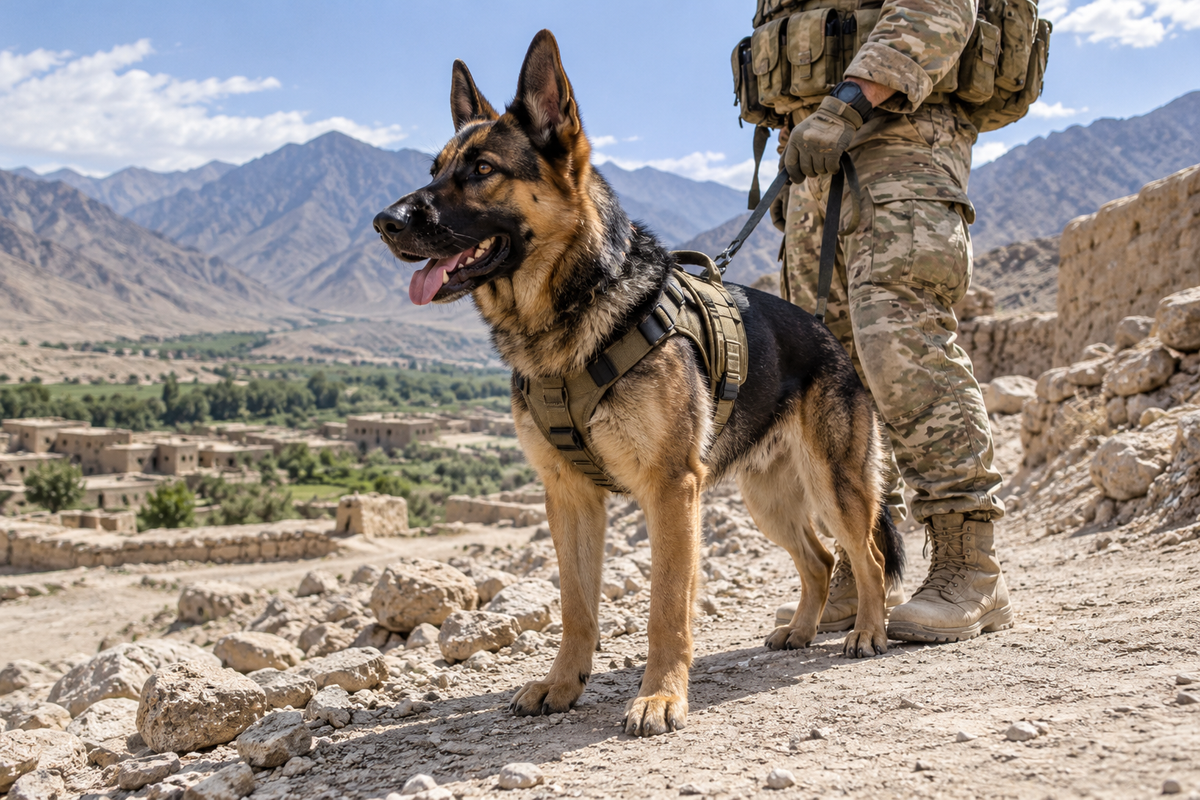
An armed fighter opened fire on her from point-blank range, four times, inside a darkened building. She did not run. She finished the fight, on three working legs, and saved every soldier behind her.This is the story of Layka, a Belgian Malinois who served with the U.S. Army in Afghanistan, and whose refusal to back down under direct gunfire became one of the defining stories of modern military working dogs, and whose gentleness, once she came home, surprised even the people closest to her.
A breed built never to back down
The Belgian Malinois began as a Belgian herding breed, but over the last several decades modern military and police forces around the world have come to trust it above nearly any other breed for the most physically demanding and dangerous work, precisely because of its combination of athleticism, drive, and a refusal to retreat under direct pressure that few other breeds can reliably match. Layka, who served with the United States Army in Afghanistan, embodied that trait as completely and as literally as any dog in the breed's long operational history.
The most dangerous job on the mission
Layka's handler was an Army Ranger named Julian McDonald. Their assigned role, whenever a team needed to clear a building during an operation, was among the most dangerous work on any mission: Layka went in first, ahead of the human soldiers, into whatever darkness or uncertainty waited inside, to find whatever, or whoever, was hiding there before anyone else had to.
2012: a building with an armed fighter hidden inside
During a mission in 2012, Layka's team reached a building known or suspected to be sheltering an armed fighter. Layka went in first, exactly as she always did, without hesitation.
The fighter fired at her from point-blank range. Once. Twice. Three times. Four times, in rapid succession.
Layka didn't run.
She finished what she started
Despite her wounds, mounting with each shot, Layka attacked and ultimately subdued the fighter, protecting Julian and the soldiers moving in behind her from the direct threat he still posed. Only once the immediate situation was fully under control did Julian reach her side.
She had been shot four separate times. She was bleeding heavily. The bullets had destroyed the ball-and-socket joint of her right front leg beyond any realistic hope of repair. Battlefield medics worked quickly to save her life, but despite their best efforts, they could not save the leg itself.
A life worth remembering
A story of courage, and a life beyond it.
Three legs, and a war that was finally over
After hours of emergency surgery, Layka came home with three legs instead of four. Her active service in Afghanistan was finished for good, and Julian, who had fought alongside her through the mission that cost her the leg, wasn't willing to let her simply be reassigned or retired anonymously elsewhere. He petitioned to formally adopt her, and Layka went on to spend the rest of her life with Julian and his family, far from the battlefield that had nearly cost her everything.
From combat to a little boy's best friend
Some people, understandably, worried that a dog trained so intensively for the brutal realities of combat could never successfully adjust to the gentler rhythms of an ordinary family home. Layka proved those worries wrong almost immediately. She formed a close, easy bond with Julian's young son, patiently allowing him to tug gently at her ears, poke curiously at her nose, and even put his small hand inside her mouth without a trace of concern on her part, remarkable gentleness from a dog who had, not long before, fought off an armed attacker under direct fire.
Videos of the powerful, battle-scarred war dog being so tender with the little boy were shared widely online in the years that followed, and millions of people around the world came to know her story, not primarily as a wounded soldier, though she certainly was one, but as a soldier who had quietly, completely, and successfully come home.
Into the dark, so they wouldn't have to be
Layka went into the most dangerous darkness a building could offer, over and over across her deployment, specifically so that the soldiers moving in behind her wouldn't have to take that first, most dangerous step themselves. And when the fighting was finally over for her, she came home to exactly the kind of ordinary, peaceful family life that her entire service had, in its own way, been spent helping to protect other people's chance at having.
The particular risk of building-clearing work
Of all the roles assigned to military working dogs in Iraq and Afghanistan, close-quarters building clearance is widely regarded by handlers as carrying some of the highest individual risk, since it places the dog in direct, immediate proximity to an unknown and potentially armed threat with essentially no advance warning, unlike the more gradual approach possible in open-terrain explosive detection work. Dogs selected for this kind of role are typically chosen specifically for a combination of aggression control, physical power, and unusually high pain tolerance under stress, qualities the Belgian Malinois breed is particularly noted for among military trainers, and qualities Layka demonstrated in the clearest possible terms during the 2012 engagement that nearly cost her life.
A story that reshaped public perception
Layka's recovery and subsequent adoption received considerable media coverage in the years following her injury, in part because her story offered a counterpoint to a more common narrative at the time, in which severely wounded military working dogs were sometimes euthanized or permanently retired to kennels rather than placed with families. Advocacy groups working to reform adoption policies for retired military working dogs cited Layka's case specifically as evidence that a combat-injured dog, given the chance, could transition successfully and safely into an ordinary civilian household, an argument that contributed to broader policy changes making such adoptions easier for handlers and military families in the years that followed.
A second life that defied expectations
Veterinary and behavioural specialists who work with retired combat dogs have noted that the transition to family life is not always straightforward even for dogs without major physical injuries, since the hyper-vigilance and reactivity that make a dog effective in a combat zone can, without careful management, translate poorly into an ordinary household environment full of unpredictable children, visitors, and everyday noise. Layka's adjustment was closely observed by both veterinary staff and, informally, by online audiences following the widely shared videos of her with Julian's son, and her evident comfort in that environment became something of a reference point for adoption advocates making the case that even dogs who had experienced severe combat trauma could, with the right placement and the right handler, settle fully and safely into civilian family life.
A story shared well beyond military circles
The videos of Layka with Julian's son reached an audience far wider than most military working-dog stories typically do, circulating widely on social media platforms in a way that introduced millions of people, many with no particular connection to the military, to the realities of what combat working dogs experience and how they can recover afterward. For Julian, the attention was, by his own account, secondary to the simple fact of having his partner home and safe with his family; for many of the people watching, though, the footage offered a rare, accessible window into a world most civilians never see directly, the quiet, patient work of rebuilding trust after trauma, playing out in real time between a decorated war dog and a small child who had no idea, in the moment, just how much that particular dog had already survived.
A record that stands on its own among war dogs
Being shot four times at point-blank range by an armed combatant and still successfully completing the engagement is an outcome that military veterinarians who have reviewed her case describe as exceptionally rare, given the typical severity and immediacy of injuries sustained in that kind of close-range exchange. Most dogs facing comparable wounds would be expected to retreat or become incapacitated well before subduing an active threat; Layka's survival and continued effectiveness through that specific sequence of events is frequently cited in military working-dog training discussions as an extreme, almost statistical outlier, illustrating both the breed's physical resilience and the sheer force of trained drive under combat conditions.
Remember the name
Layka at a glance
- Breed: Belgian Malinois
- Service: U.S. Army, Afghanistan
- Handler: Army Ranger Julian McDonald
- Known for: Subduing an armed fighter after being shot four times at point-blank range during a 2012 building-clearing mission
- Injury: Lost her right front leg; underwent extensive surgery to save her life
- Later life: Adopted by handler Julian McDonald and his family; became known for her gentleness with his young son
Further reading: War dog Layka lost a leg saving her team, Military.com, U.S. Army working dog program, Army Times
Love Layka's story? Shop the Layka Sweatshirt and bring it home.
The story stays with us
Remember Layka.
Explore the tributes inspired by Layka's story, or meet another dog whose life deserves to be remembered.