
The story behind the tribute
Lucca: The Marine Dog Who Never Lost a Marine
A remarkable life. A lasting bond. A story that deserves to be remembered.
The life behind the tribute
Remember Lucca.
For six years and more than four hundred missions, she walked in front of the soldiers so that any bomb would find her first. Not one Marine on her patrols was ever hurt.This is the story of Lucca, a military working dog whose nose kept an entire chain of Marines alive through Iraq and Afghanistan, and who paid for it with a leg of her own, before coming home to live out her final years with the man who had trained her as a young dog.
Bred for a nose that misses nothing
Lucca was a mix of German Shepherd and Belgian Malinois, two breeds that have become the backbone of modern military and police working-dog programs around the world, prized above all for scenting ability sharp enough to detect concealed explosives from distances and depths no human searcher could ever hope to match. She was trained as a young dog by a Marine named Chris Willingham, and her job description, once she reached the field, was simple to state and among the most dangerous in the entire war: walk in front of the soldiers, and find the bombs before they did.
Six years, four hundred missions, zero injuries
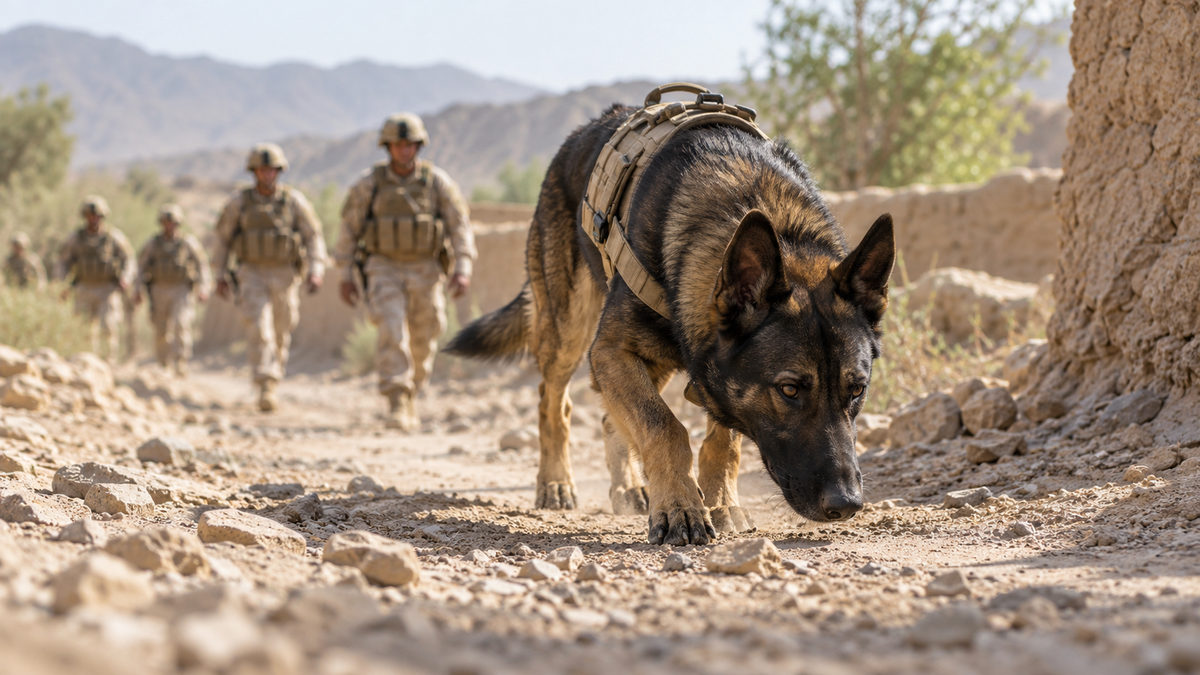
Lucca served first in Iraq, and later in Afghanistan, working as an Improvised Explosive Device detection dog attached to Marine units on patrol. On every mission, she walked ahead of the formation, nose low to the ground, scanning constantly for the specific chemical signatures of buried explosives, and the Marines behind her followed deliberately in her exact footsteps, because her footsteps were, by definition, the safest ground available to them. Over more than six years of this unrelenting work, she completed more than four hundred individual missions. In all that time, not a single Marine on a patrol she led was ever hurt by an explosive device, a record few military working dogs in history can claim at that scale.
Helmand, March 2012
By March 2012, Lucca's handler was Corporal Juan Rodriguez, who had taken over working with her as part of the normal rotation of Marine dog handlers through deployment cycles. On patrol in Helmand Province, Afghanistan, one of the most heavily contested and IED-laden regions of the entire conflict, Lucca found a bomb: thirty pounds of buried explosives hidden directly in the patrol's path. The Marines marked the location for safe disposal. Lucca, trained to continue clearing the surrounding area rather than stop at a single find, kept searching.
Then a second, hidden device detonated directly beneath her.
What Juan found when the dust cleared
When the dust and debris settled, Juan ran to her position. Her front leg was gone entirely. Her chest had been badly burned in the blast. He tied a tourniquet on the spot, held her steady, and carried her out of the area himself rather than waiting for a stretcher team. She survived, one of those moments where a handler's own immediate, decisive action, combined with a dog's own sheer will to hold on, made the difference between a story that ends in grief and one that, against the odds, does not.
A life worth remembering
A bond built on extraordinary trust.
Learning to walk again, on three legs
Lucca came home from that deployment with three legs instead of four. Her active military service was over, but her story was very much not. She had to relearn, step by step, how to walk on her new balance, and then, with time and determined rehabilitation, how to run again. And the man who had trained her as a young dog years before she ever deployed, Chris Willingham, came forward, formally adopted her, and brought her home to live with him for good.
The first Marine Corps dog to receive the Dickin Medal
In 2016, Lucca became the first Marine Corps working dog ever awarded the Dickin Medal, the United Kingdom's highest honour for animal gallantry in war, sometimes described as the animal world's Victoria Cross. The medal was given not for one isolated dramatic act, but for six years of unbroken, relentlessly dangerous, and quietly heroic work across hundreds of missions, recognition of an entire career rather than a single moment within it.
A long rest, finally
Lucca lived out her remaining years with Chris, on soft grass, far removed from any war zone and the daily threat that had defined her working life. In 2018, at fourteen years old, she died with him beside her, the same man who had first trained her as a young, untested dog, and who was there again, more than a decade on, to see her safely to the very end.
In front, so her Marines wouldn't have to be
For six years, across hundreds of missions, Lucca walked in front of the men she served with so that they wouldn't have to take the risk of leading themselves. On the day it finally cost her a leg, she was still exactly where she had always chosen to be: in front. Somewhere today, a number of Marines who served alongside her are almost certainly alive because of a dog they could never properly thank in a language she understood, only through the care and the home that followed, for as long as she lived.
What an IED dog's job actually involves
Improvised explosive devices were, for much of the Iraq and Afghanistan wars, the single leading cause of casualties among coalition forces, often buried undetectable to the naked eye along footpaths, roadways, and building entrances. Specially trained detection dogs like Lucca worked off-leash ahead of their units specifically because their handlers needed distance between the dog and any potential blast, while still relying entirely on the dog's nose to catch what human searchers, metal detectors, and ground-penetrating equipment sometimes missed. The work demanded total concentration for hours at a stretch, in extreme heat, over unpredictable terrain, with the physical and psychological toll of the job recognized today as comparable in many respects to that faced by the human service members working alongside these dogs.
A recognition years in the making
The Dickin Medal, instituted in Britain in 1943, had historically gone to a relatively small number of American recipients, and Lucca's award in 2016 marked a significant milestone specifically for United States Marine Corps working dogs, whose contributions during the Iraq and Afghanistan conflicts had, by the admission of several military historians, gone comparatively under-recognized relative to their actual operational impact. The ceremony, held in London, drew international press coverage not only for Lucca's individual record but as a wider moment of public recognition for the thousands of military working dogs who served, largely without public acknowledgment, across both conflicts.
A statistic that is easy to state and hard to achieve
"Zero Marines injured across more than four hundred missions" is a remarkably simple figure to write down, and a genuinely extraordinary one to actually sustain across six years of continuous deployment in two different war zones. Military analysts who have studied IED-detection dog performance note that the margin for error in this kind of work is essentially zero, a single missed detection can result in catastrophic casualties, which makes Lucca's unbroken safety record across hundreds of patrols one of the more statistically remarkable individual performance records attributed to any single military working dog from either conflict, Marine Corps or otherwise.
A story told alongside her handlers', not instead of it
Coverage of Lucca's Dickin Medal frequently made a point of crediting both Chris Willingham and Juan Rodriguez by name, treating her award less as a story about one exceptional dog in isolation and more as a recognition of an entire working partnership spanning multiple handlers over six years of continuous deployment. That framing reflects a broader shift in how military working-dog achievements have increasingly been reported in recent years, less as novelty animal-interest stories detached from their human context, and more as an integrated part of the same combat and casualty narratives applied to any other service member, with handlers' names and units specified alongside the dog's own record rather than left out of it.
Remember the name
Lucca at a glance
- Breed: German Shepherd / Belgian Malinois mix
- Trainer and later owner: Marine Chris Willingham
- Handler at time of injury: Corporal Juan Rodriguez
- Service: U.S. Marine Corps, Iraq and Afghanistan, over 400 missions across six-plus years
- Injury: Lost her right front leg to an IED in Helmand Province, March 2012
- Honor: First Marine Corps dog to receive the Dickin Medal, 2016
- Died: 2018, at age fourteen, with Chris Willingham
Further reading: Lucca, PDSA Dickin Medal citation, Retired Marine Corps dog Lucca receives animal Victoria Cross, Military.com
Love Lucca's story? Shop the Lucca Sweatshirt and bring it home.
The story stays with us
Remember Lucca.
Explore the tributes inspired by Lucca's story, or meet another dog whose life deserves to be remembered.