
The story behind the tribute
Rip: The Blitz's Unofficial Rescue Dog
A remarkable life. A lasting bond. A story that deserves to be remembered.
The life behind the tribute
Remember Rip.
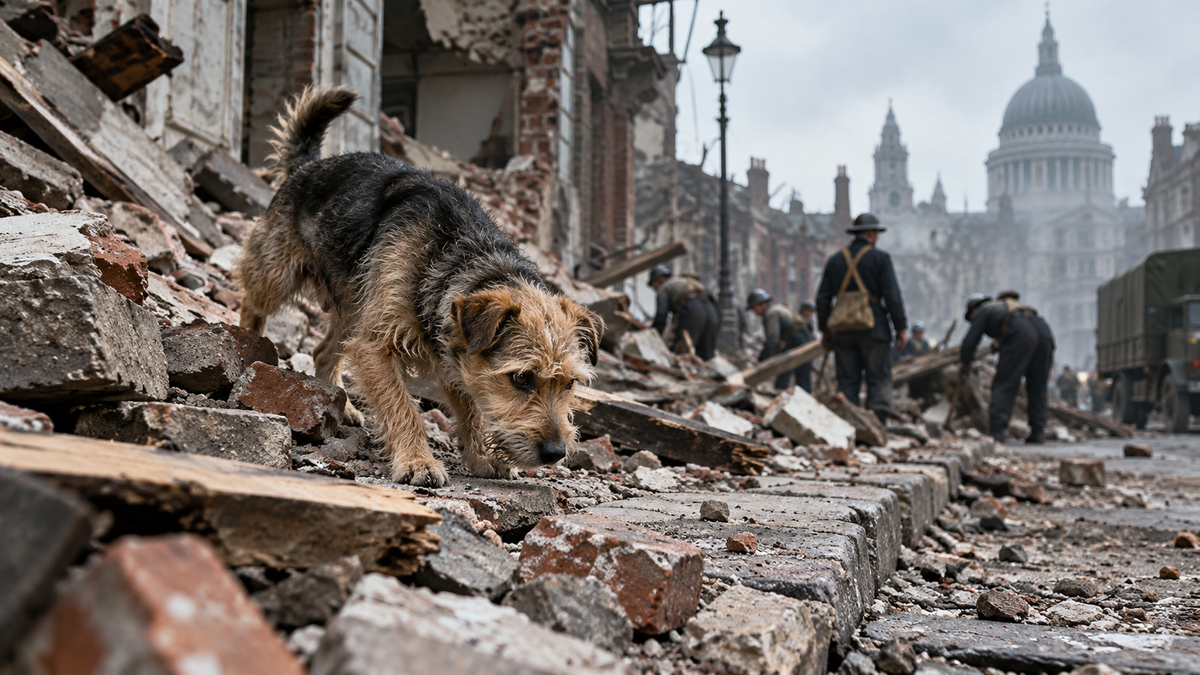
Nobody trained him. Nobody taught him what to do. A stray dog taken in by an air raid warden simply walked to the first pile of bombed rubble he saw, and started to dig.This is the story of Rip, a scruffy terrier cross who became one of the pioneers of search-and-rescue work, locating more than a hundred people buried beneath the ruins of London during the Blitz, entirely without formal training, at a time when no such training even existed.
A stray with a digger's instinct
Rip was a scruffy terrier cross of unknown exact parentage, the kind of dog built, like most terrier breeds, around a strong instinct to dig and to go after things hidden deep underground, a trait originally bred into terriers for hunting vermin and small game out of burrows. In 1940, London was being bombed by the German air force almost every single night, in a sustained, months-long campaign that came to be known in Britain as the Blitz.
Found in the rubble himself
After one particularly heavy raid on the Poplar district in London's East End, an air raid warden named Mr King came across a stray dog wandering through the rubble left behind, hungry, filthy, and entirely alone, with no sign of an owner anywhere nearby. Mr King gave him some scraps of food out of simple kindness. Rip, rather than moving on, stayed with him.
Every night, the same work
Every single night through that period, air raid sirens wailed across London, warning residents to take shelter. The bombs fell regardless, night after night. Houses collapsed directly onto the families sheltering inside them, sometimes with no warning at all. And every morning that followed, Mr King and the other local air raid wardens went back out into the ruined streets to dig through whatever remained, searching urgently for anyone who might still be alive somewhere beneath the wreckage.
Rip went with them each time, without being asked.
Teaching himself a method
Nobody had trained Rip for any of this, formal search-and-rescue dog training, in any organized or systematic sense, simply didn't exist yet anywhere in the world at that point in history. Nobody had taught him what specific scent to look for, or how to signal when he found it. But he went directly to the piles of broken brick and shattered timber entirely on his own initiative, and began sniffing methodically across the debris.
Then, at a particular spot, he would stop abruptly, and begin to dig with real urgency. The wardens quickly learned, through repeated experience, to dig wherever Rip chose to dig, trusting his instinct over their own guesswork.
And time and again, underneath, there were people. Some of them, remarkably, were still alive when found.
A life worth remembering
Care can begin without being asked.
A hundred lives, one raid at a time
Night after night, raid after relentless raid, Rip continued searching through the smoke and settling dust of other people's destroyed homes, often working for hours at a stretch in dangerous, unstable conditions. In just twelve months, between 1940 and 1941, he was officially credited with locating more than one hundred separate victims buried beneath the bombed streets of London, an extraordinary total for any search dog, let alone one working without any formal training whatsoever.
He was, by any reasonable account, a stray that nobody had originally wanted or claimed, transformed through nothing but raw instinct and sheer persistence into one of the single most effective search dogs operating anywhere in wartime Britain.
Recognition, five years on
In July 1945, once the war in Europe had finally ended, Rip was formally awarded the Dickin Medal, the animal world's equivalent of the Victoria Cross. His official citation read simply and directly: "For locating many air raid victims during the Blitz of 1940." He went on to live for several more years after the war before dying in October 1946, and was buried in the PDSA Animal Cemetery in Ilford, east London.
He just kept digging until he found them
Nobody trained Rip for any part of what he did. Nobody formally asked him to take on the work he chose, night after night, entirely of his own accord. He simply kept digging, raid after raid through one of the most sustained bombing campaigns of the entire war, until he found the people buried beneath the rubble of their own homes, a hundred times over and more, starting from a stray dog that no one in London had originally wanted at all.
The Blitz, in brief
The Blitz refers to the sustained German bombing campaign against British cities between September 1940 and May 1941, with London bearing the brunt of the early and most intensive raids. Over that period, tens of thousands of civilians were killed across the country, and hundreds of thousands of homes were damaged or destroyed, with London's East End, including the Poplar district where Rip was found, among the hardest-hit areas of the city, owing partly to its proximity to the heavily targeted docklands. Air raid wardens like Mr King were civilian volunteers responsible for enforcing blackout regulations, directing people to shelters during raids, and, in the aftermath of each night's bombing, helping coordinate the search for casualties trapped in the ruins, exactly the kind of work Rip attached himself to almost immediately.
Laying the groundwork for a modern discipline
Formal search-and-rescue dog training as it exists today, with standardized certification programs and internationally recognized search protocols, did not begin to take shape in any organized way until well after the Second World War. Rip's wartime work, along with that of a small number of other dogs who performed similar rubble-search duties during the Blitz, is frequently cited by historians of the discipline as an important, if entirely informal and accidental, proof of concept, evidence, witnessed firsthand by wardens across bombed British cities, that a dog's nose could reliably locate buried survivors faster and more effectively than human searchers working with hand tools alone, decades before anyone had formally systematized how to train for it.
A record kept amid chaos
Precise record-keeping during the Blitz was, understandably, not always a priority for exhausted air raid wardens working through consecutive nights of bombing, and the specific figure of "more than one hundred" victims attributed to Rip comes from contemporaneous reports compiled by the organization that would eventually award him the Dickin Medal, cross-referenced where possible against local warden logs from the period. Historians studying the Blitz's civilian rescue efforts note that this kind of informal, after-the-fact documentation was fairly typical for recognizing acts of civilian heroism during the war, when the overwhelming priority night after night was simply getting through the raid itself, with formal recordkeeping necessarily taking a distant second place.
A medal that arrived relatively early
Unlike several of the dogs honoured for wartime service whose recognition came years or even decades after the fact, Rip's Dickin Medal was awarded in July 1945, within months of the European war's end and while many of the people who had directly witnessed his rescue work in Poplar were still alive, still local, and still able to confirm the accounts firsthand. That relative immediacy gives his citation a degree of documented certainty that some later, more reconstructed wartime animal stories lack, a straightforward, contemporaneously verified record of a stray dog who taught himself, through nothing but instinct and repetition, to find people trapped beneath the ruins of their own bombed homes.
A stray who changed how a warden's job was done
Mr King and the other wardens in his district reportedly adjusted elements of their own search routine once they recognized how effective Rip's instincts were, prioritizing locations he showed interest in over a purely systematic grid search of the rubble, a practical, informal adaptation made on the ground by people with no prior framework for incorporating a dog's scenting ability into their work. That kind of trust, extended by exhausted wardens working under constant threat of further bombing, speaks to how quickly Rip's reliability became apparent to the people who worked alongside him night after night, long before any formal recognition caught up with what they had already come to depend on.
Remember the name
Rip at a glance
- Breed: Terrier cross
- Found: Poplar, East London, after an air raid in 1940, by warden Mr King
- Known for: Self-taught rescue work locating more than 100 Blitz casualties buried in rubble between 1940 and 1941
- Honor: Dickin Medal, awarded July 1945
- Died: October 1946; buried in the PDSA Animal Cemetery, Ilford
- Legacy: Regarded as one of the earliest search-and-rescue dogs in recorded history
Further reading: Rip, PDSA Dickin Medal citation, Animals that went to war, Imperial War Museums
Love Rip's story? Shop the Rip Sweatshirt and bring it home.
The story stays with us
Remember Rip.
Explore the tributes inspired by Rip's story, or meet another dog whose life deserves to be remembered.