
The story behind the tribute
Shep: Five and a Half Years at the Station
A remarkable life. A lasting bond. A story that deserves to be remembered.
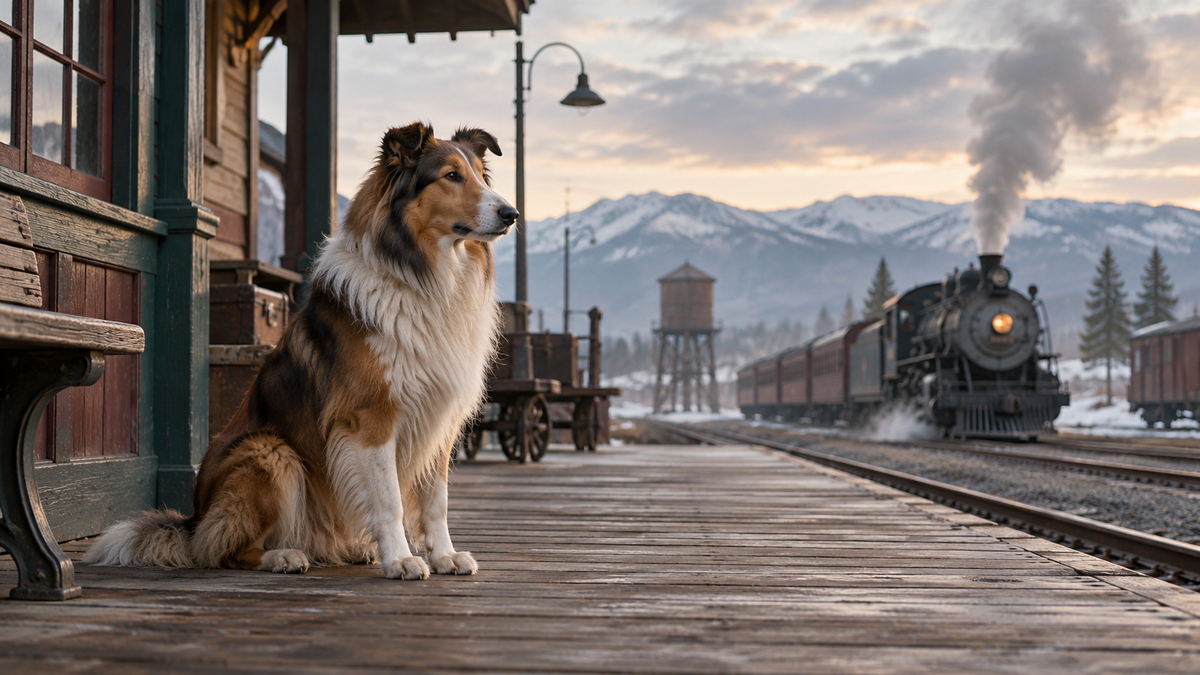
The life behind the tribute
Remember Shep.
He watched his owner's coffin loaded onto a train and pull away. Then he waited at that same station for five and a half years, meeting every train that came in, until one finally failed to stop in time.This is the story of Shep, a sheepdog from Fort Benton, Montana, whose vigil at a small railway platform became one of the most widely recognized stories of canine devotion in American history, drawing visitors from across the country for years.
Bred never to leave one behind
Sheepdogs, as a working category rather than a single breed, are bred around one overriding instinct: to guard a flock continuously and never leave a single animal unaccounted for, regardless of weather, distance, or time of day. It is an instinct built for the open range, where a shepherd might be out of sight for hours and the dog alone is responsible for keeping the group together. Shep, who belonged to an aging sheepherder in Fort Benton, Montana, carried that same deep instinct with him, it simply found an entirely different, and far more singular, kind of flock to watch over once his owner's life changed.
A sheepherder's final journey
In the summer of 1936, Shep's elderly owner fell seriously ill and was taken into the town hospital in Fort Benton. Shep followed him there and stationed himself by the door, where sympathetic nurses fed him scraps while his owner's condition steadily worsened over the following days. A few days later, the sheepherder died in the hospital.
His family, who lived back East, asked for his body to be shipped home to them for burial. So his coffin was carried through town to the Fort Benton railway station and loaded onto a waiting train.
Shep followed it the entire way there.
Watching the train pull away
He watched the railway workers lift the coffin into the train car. He watched the doors close behind it. He watched the train pull slowly out of the station and disappear down the tracks, carrying away the one person he had, in all likelihood, ever truly belonged to.
Then, rather than return to any kind of normal life in the town, he simply stayed at the station.
Meeting every train
The next train came into the station. Shep watched every single passenger step off, searching each face for the one he was looking for. Then the next train arrived, and he did it again, and the next after that. Fort Benton had four scheduled trains passing through each day in that era, and Shep made a point of meeting every single one of them, without exception, through brutal Montana summers and through Montana winters that regularly dropped well below freezing.
People in town tried repeatedly to take him home and give him a warm house and a family of his own to live with. He refused to go with anyone, consistently choosing the platform over any offered comfort. Eventually the railway workers themselves simply started feeding him regularly and let him sleep in a sheltered spot under the platform, accepting, as the town around them gradually did too, that this was where he had decided he needed to be.
A life worth remembering
The places we wait can become places of remembrance.
A story that spread across the country
What began as a local curiosity became, over the following years, a story people across America read about and followed. One year became three, then five. Travelers heading through Montana changed their routes specifically to stop in Fort Benton and see the famous waiting dog for themselves. Children moved by the story mailed him presents at Christmas, year after year, addressed simply to "Shep, Fort Benton, Montana."
Shep grew old at his self-appointed post. His hearing, once sharp enough to catch the distant sound of an approaching train, began to fail with age. His legs grew stiff and slower. And still, whenever a train approached, however faintly he could now sense it, he made his way to the platform to check, exactly as he had for years.
A cold morning in January 1942
On a cold January morning in 1942, Shep was waiting on the tracks as a train came into the station, just as he had thousands of times before. By then, with his hearing mostly gone, he didn't hear it closing the distance in time.
The whole town turned out for his funeral. Local Boy Scouts carried his body up the hill overlooking the station, and he was buried there, in a spot that still looks directly down over the tracks he had watched for more than five years.
Five and a half years, never once leaving
Sheepdogs are bred never to leave one behind. Shep held to that instinct long after any practical reason for it had passed, continuing for five and a half unbroken years, through every season Montana could throw at him, without a single documented lapse. He never truly did leave his post, not until the very thing he had spent all those years watching for finally, tragically, caught up with him instead.
A story that became part of American railroad folklore
Shep's vigil took place during the Great Depression and into the early years of the Second World War, a period when stories of loyalty and simple endurance against hard circumstances resonated especially strongly with a national audience facing its own prolonged hardships. Railroad employees across the wider Great Northern Railway network, which operated the line through Fort Benton, reportedly took a particular interest in his welfare, informally looking out for him even when he wasn't directly under the care of the local station staff, aware that his story had become something the railway itself was, in a sense, now associated with.
Remembered long after the trains stopped
Passenger rail service through Fort Benton eventually declined and was discontinued decades after Shep's death, as happened to many small-town stations across rural America during the second half of the twentieth century. Despite that, his story continued to be retold locally and in regional histories of Montana, and in 1994 the town formally commissioned and erected the bronze statue that still stands there today, ensuring that even after the trains themselves stopped running, the dog who waited for them would not be forgotten by the town that had, in its own way, waited alongside him.
A small town shaped by one dog's routine
Fort Benton in the late 1930s and early 1940s was a modest agricultural and ranching community along the Missouri River, and the arrival and departure of the daily trains represented one of the town's few regular connections to the wider world beyond Montana. Shep's presence at the station, repeated four times a day without fail for more than five years, effectively became woven into that daily rhythm, townspeople and railway staff alike came to treat his appearance on the platform as background routine, even as outsiders who learned the full story behind it increasingly found it extraordinary. It is partly that contrast, between a story so ordinary to the people who lived alongside it and so remarkable to everyone encountering it for the first time, that helped Shep's story travel so far beyond Fort Benton's own small population.
A grave that still faces the tracks
The decision to bury Shep on the hill directly overlooking the station, rather than in any more conventional location, was a deliberate choice by the townspeople who organized his funeral, intended specifically to let him continue, in a symbolic sense, to watch over the tracks he had spent more than five years monitoring in life. Visitors to Fort Benton today can walk the same route from the grave down to the restored station platform and the accompanying statue, a short, quiet pilgrimage that local tourism materials describe as the single most requested stop for visitors who come to the small Montana town specifically because of his story.
A story shared with other famous waiting dogs
Shep's vigil is frequently mentioned alongside other well-known stories of dogs waiting for a lost owner at a train station or similar point of departure, including Hachikō in Japan, whose own wait at Shibuya Station overlapped partly in era and whose fame eventually reached Montana as well, prompting local comparisons at the time. What distinguishes Shep's case within that broader category is the specific, repeated nature of his routine, not simply remaining near one fixed location, but actively meeting each of four separate daily trains without fail, a level of consistent, deliberate engagement with the actual schedule of trains that sets his documented behaviour apart even among similarly themed stories from other countries and eras.
Remember the name
Shep at a glance
- Breed: Sheepdog (Collie-type)
- Home: Fort Benton, Montana
- Known for: Meeting every train at the Fort Benton station for five and a half years after his owner's coffin departed by rail in 1936
- Died: January 1942, on the tracks at Fort Benton station
- Legacy: Buried on the hill overlooking the station; a statue of Shep stands in Fort Benton today
Further reading: Shep the Dog statue, Atlas Obscura, Shep, Fort Benton's Faithful Dog, Montana Historical Society
Love Shep's story? Shop the Shep Sweatshirt and bring it home.
The story stays with us
Remember Shep.
Explore the tributes inspired by Shep's story, or meet another dog whose life deserves to be remembered.