
The story behind the tribute
Smoky: The Four-Pound War Hero
A remarkable life. A lasting bond. A story that deserves to be remembered.
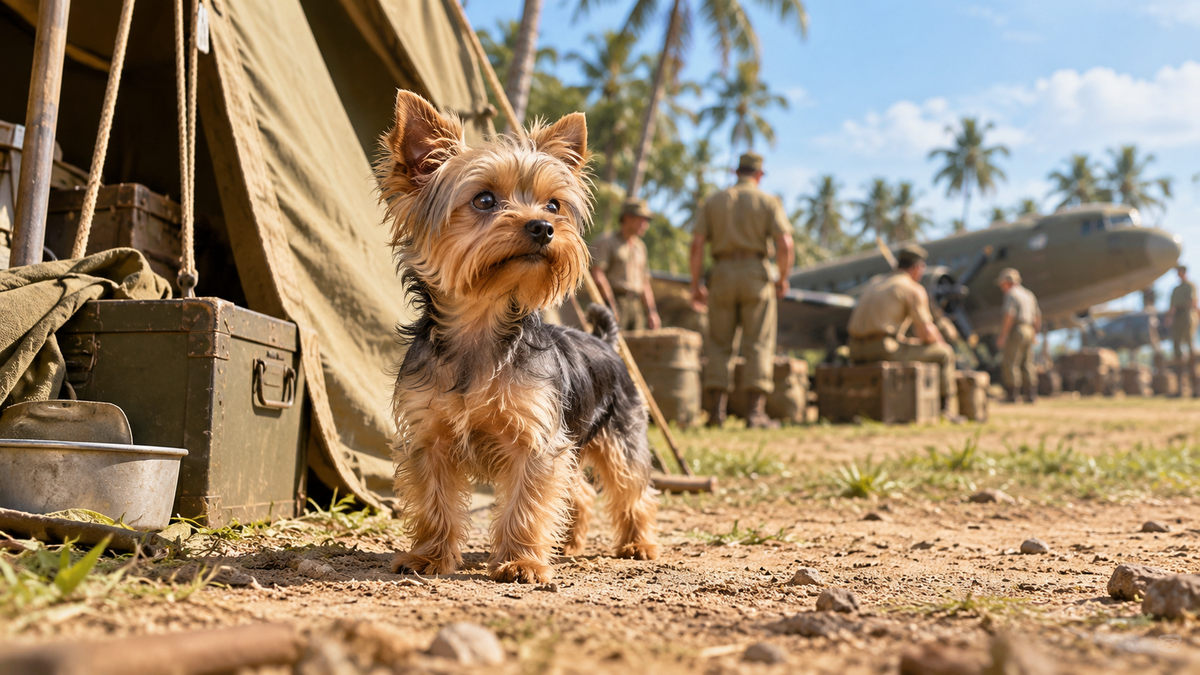
The life behind the tribute
Remember Smoky.
A soldier found a four-pound dog sitting alone in an abandoned jungle foxhole and sold her for the equivalent of six dollars. She went on to crawl through a seventy-foot pipe under enemy fire and became one of the first therapy dogs in history.This is the story of Smoky, a Yorkshire Terrier of uncertain origin who flew combat missions in the Pacific, survived a typhoon, and ended the Second World War as perhaps its smallest and most unlikely soldier.
Bred to fit where nothing bigger could
The Yorkshire Terrier was originally bred in nineteenth-century England to chase rats through the narrowest gaps in textile mills and coal mines, tiny, cramped spaces where nothing larger could possibly follow. Smoky carried that same compact build to a genuine extreme: barely bigger than a man's boot, weighing only about four pounds, and standing just seven inches tall at the shoulder. Nothing about her size suggested she would ever see active combat duty of any kind.
Found in a foxhole, no questions answered
In 1944, deep in the jungles of New Guinea, in the middle of the Second World War's brutal Pacific campaign, an American soldier happened to look into an abandoned foxhole and found a tiny dog sitting inside it, apparently abandoned or lost. Nobody around at the time ever discovered where she had originally come from, or how she had ended up alone in a combat zone. The soldier who found her sold her almost immediately to a corporal named Bill Wynne for two Australian pounds, roughly six dollars at the time, and promptly went straight back to the poker game he had been playing.
From that day forward, Smoky went essentially everywhere Bill went.
A dog who went to war, in the smallest possible sense
Smoky slept curled up in Bill's tent each night. She ate directly from his military rations. Remarkably for a dog her size, she flew on twelve separate combat and reconnaissance missions over the course of the war, survived more than one hundred fifty separate air raids without serious injury, and lived through a major typhoon alongside the men she had attached herself to.
On one occasion, aboard a landing craft during an operation, she alerted Bill to incoming shellfire moments before anyone else on board noticed the threat. He moved immediately. Eight men standing nearby at the time were hit by the shelling. From that point on, Bill began calling her his "angel from a foxhole," a nickname that stuck with her for the rest of her life.
Seventy feet of pipe, eight inches wide
Then came the single mission that ultimately made her famous well beyond her own unit. In the Philippines, military engineers needed to run a telegraph wire beneath an active airfield at Lingayen Gulf, on the island of Luzon, through an existing pipe seventy feet long and only eight inches wide, with the opening half blocked by accumulated dirt and debris.
Digging the pipe up by hand to lay the wire conventionally would have taken a full three days of exposed work, and would have put hundreds of men directly out in the open, under constant risk of enemy fire, for the entire duration.
Or, as someone eventually suggested, they could send Smoky instead.
A life worth remembering
Small paws can leave a remarkable mark.
Into the dark, through the dirt
Bill tied a length of string to her collar, attached the loose end of the string to the telegraph wire that needed running through, and called to her encouragingly from the far end of the pipe. She crawled forward into the complete darkness. Through packed dirt. Through tight spots where she had no choice but to stop, work herself free, and push forward again, inch by inch.
At the far end of the pipe, after what felt like a very long wait, Bill finally saw two small eyes appear out of the darkness. The job that would otherwise have taken three full days of genuinely dangerous manual digging had taken Smoky a matter of minutes to complete on her own.
The first documented therapy dog
After the war ended, Smoky continued working in her own way, visiting wounded soldiers recovering in military hospitals and offering them the same uncomplicated comfort she had once offered Bill in a tent in the New Guinea jungle. She is widely credited today as the first documented therapy dog in recorded history, a role that, decades later, would go on to become a formally recognized and clinically studied form of treatment in hospitals around the world.
Remembered near a river in Ohio
When Smoky finally died in 1957, well after the war had ended, Bill buried her near a tree in Cleveland's Rocky River Reservation, close to where the two of them had settled after he returned home. Years later, her remains were carefully moved and placed inside a genuine Second World War ammunition box, buried beneath a permanent monument built specifically in her honour at the same location.
The smallest soldier got through
Yorkshire Terriers, as a breed, were bred generations earlier to go where nothing else could physically fit. In a war fought largely by giants, massive aircraft, warships, entire armies numbering in the millions, it was ultimately the smallest soldier involved in any of it who crawled through a space no human being ever could have managed, and finished a job that would otherwise have cost real lives to complete the ordinary way.
A war fought in extreme conditions
The New Guinea and Philippines campaigns Smoky served through were fought in some of the harshest conditions of the entire Pacific War, combining dense jungle terrain, tropical disease, extreme heat and humidity, and sustained combat that tested the endurance of even well-equipped, well-supplied troops. Smoky's small size, which might have seemed a liability in combat, turned out in practice to be part of what made her so valuable: she could be carried easily during long marches, fed from standard rations without difficulty, and, as the Lingayen Gulf mission demonstrated most dramatically, fit into spaces that offered a genuine tactical advantage no larger animal or piece of equipment could have matched.
A legacy recognized well beyond her own lifetime
Smoky's story has been documented extensively in subsequent decades, including in a dedicated biography written by Bill Wynne himself and in multiple later academic and popular accounts of the early history of animal-assisted therapy. The American Kennel Club and various veterinary and military history organizations have continued to cite her specifically as a foundational case study whenever the broader history of therapy animals is discussed, crediting her hospital visits in the years immediately following the war with helping establish, well before the term itself was in common use, the basic template for what a therapy-animal visit could look like and accomplish for recovering patients.
A record unusual for her size and status
Smoky was never formally enlisted or officially recognized as a military animal during the war itself, by the standards of the time, she was simply a soldier's unofficial pet who happened to accompany him into combat zones. That informal status makes her documented service record, pieced together largely from Bill Wynne's own wartime diaries and later recollections, all the more unusual: twelve combat missions, more than 150 air raids survived, and one engineering problem solved in minutes that would otherwise have taken days and put hundreds of men at risk, all achieved by a dog with no formal military designation whatsoever, acquired for the price of a card game wager.
A small dog's outsized place in military history
Military museums and veterans' organizations that document the Pacific campaign have, in subsequent decades, specifically sought out Smoky's story as a counterpoint to the scale and grimness of much of the rest of that theatre's history, offering a smaller, more personal thread running alongside the broader accounts of major battles and strategic campaigns. Her memorial in Ohio remains a modest, specific tribute compared to the large national monuments associated with the Pacific War more generally, yet it draws a steady stream of visitors each year, many of them, according to local accounts, people specifically searching out the story of the four-pound dog who, by most tellings, earned her place in that larger history through nothing more than a willingness to crawl where she was asked to.
Remember the name
Smoky at a glance
- Breed: Yorkshire Terrier
- Size: About four pounds, seven inches tall
- Found: New Guinea, 1944, in an abandoned foxhole
- Owner: Corporal Bill Wynne, U.S. Army
- Known for: Flying twelve combat/reconnaissance missions, surviving over 150 air raids and a typhoon, and running a telegraph wire through a 70-foot pipe at Lingayen Gulf, Luzon
- Legacy: Often regarded as the first documented therapy dog
- Died: 1957; memorialized in Cleveland's Rocky River Reservation
Further reading: Smoky, the World War II hero and pioneering therapy dog, Smithsonian, Smoky, the WWII Hero Dog, American Kennel Club
Love Smoky's story? Shop the Smoky Sweatshirt and bring it home.
The story stays with us
Remember Smoky.
Explore the tributes inspired by Smoky's story, or meet another dog whose life deserves to be remembered.