
The story behind the tribute
Sully: Mission Complete
A remarkable life. A lasting bond. A story that deserves to be remembered.
The life behind the tribute
Remember Sully.
A former president, newly alone for the first time in most of his life, was given a service dog named after the pilot who landed a plane on the Hudson River. Six months later, that dog lay down beside his coffin and didn't move.This is the story of Sully, a Labrador Retriever service dog whose brief partnership with President George H. W. Bush ended in a single photograph that moved people far beyond the United States.
Bred to stay close, and to wait
Labrador Retrievers are prized in service-dog work for their calm, steady temperament and their willingness to stay close to one person for long stretches, patiently waiting for whatever small task might be needed next, without the restlessness that can make other working breeds less suited to this kind of quiet companionship. Sully, trained from early in his life specifically for service work, was named after Captain Chesley "Sully" Sullenberger, the airline pilot famous for safely landing a stricken passenger jet on the Hudson River in 2009, a name chosen, fittingly enough, for a dog whose entire purpose was built around seeing someone safely through whatever came next.
A loss that left one man entirely alone
In April 2018, Barbara Bush died. She and George H. W. Bush, the forty-first President of the United States, had been married for seventy-three years, one of the longest presidential marriages in American history. He was ninety-three years old at the time. He could no longer walk unassisted. And for essentially the first time in most of his adult life, he found himself living alone.
Two months after Barbara's death, Sully arrived at the Bush home to begin his service.
Small tasks, and one larger job
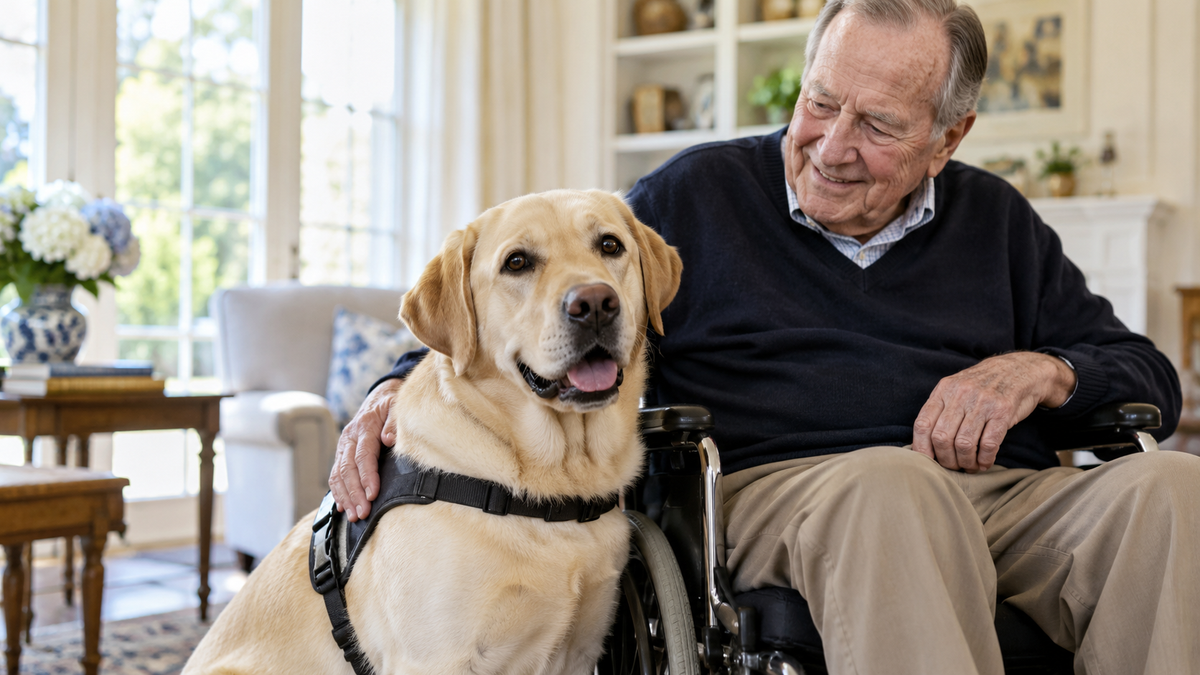
Sully was trained to perform a range of practical tasks for President Bush: opening doors, picking up whatever he dropped, and, if something went wrong, fetching help from nearby staff or family. But in practice, mostly, Sully simply stayed beside him through each day, at the family home in Texas, out on the porch of the Bush family's summer home in Kennebunkport, Maine, wherever his wheelchair happened to go. In the end, the two of them had only six months together before everything changed again.
November 30, 2018
On November 30, 2018, President Bush died. His body lay in state at a funeral home in Houston, placed in a coffin draped with the American flag, as is customary for a former president.
In front of it, without being asked, a yellow Labrador lay down on the floor.
A life worth remembering
A quiet companion. A lasting bond.
"Mission complete"
Sully didn't move from that spot. He didn't whine. He simply lay there quietly, head resting on the floor, beside the man he had spent his brief six months looking after with such evident devotion. The Bush family's spokesman took a photograph of the moment and posted it publicly online with just two words as a caption: "Mission complete."
The photograph traveled around the world within a single day, reprinted and shared across news outlets and social media in a way few images of that funeral period were.
A new mission
Sully flew alongside President Bush's body to Washington, D.C., and remained close by throughout the state funeral proceedings that followed. After that period concluded, he was given an entirely new assignment: he went to work at Walter Reed National Military Medical Center, helping wounded soldiers in the course of their own long recoveries, a continuation, in a different form, of the same quiet, patient presence he had offered President Bush.
Waiting for a command that would never come
Sully had been trained, as every service dog is, to wait patiently and attentively for his next command, whatever it might turn out to be. On that day in the Houston funeral home, in front of the flag-draped coffin, he did exactly that one final time, he lay beside his President, waiting for an order that everyone else in the room understood, with quiet sorrow, would never actually arrive. It is, in its own understated way, one of the most complete expressions of loyalty a dog has ever publicly offered: not one single dramatic rescue, but simply staying, all the way to the very last moment there was left to stay for.
Why a former president received a service dog
By the time Sully was placed with President Bush in 2018, the former president had been living for years with a form of Parkinsonism that had progressively limited his mobility, eventually confining him to a wheelchair for his final years. America's VetDogs, the organization that trained and placed Sully, specializes primarily in pairing service dogs with wounded veterans and first responders, and the Bush family's choice to work specifically with that organization was widely reported at the time as a deliberate nod to the former president's own history of military service as a young naval aviator during the Second World War, decades before he ever reached the White House.
A photograph that became a symbol
The "Mission complete" photograph taken at the Houston funeral home went on to be reprinted in obituaries, retrospectives, and tributes to President Bush for years afterward, often cited specifically as one of the most emotionally resonant images associated with his death, even among the many formal state-funeral photographs taken in the days that followed. Veterans' organizations in particular have continued to reference the image in materials about the role service dogs play not just in physical assistance, but in providing a steady, calming presence during a person's final months and years, a role that research into human-animal companionship has increasingly recognized as valuable in its own right, independent of any specific trained task.
A brief partnership with a lasting afterlife
Six months is a notably short placement for a trained service dog, and organizations that place service animals with elderly or seriously ill clients generally prepare families for the possibility that the working relationship may be cut short by the client's own health rather than any issue with the dog. What distinguishes Sully's case, in the eyes of many who have written about it since, is how much was still accomplished in that compressed window, not just the practical daily assistance, but a level of public attention to the former president's final months that gave the broader concept of late-life companion service dogs a far wider audience than it had previously reached, particularly among older Americans who might not otherwise have considered this kind of support for themselves or an aging parent.
A continuing mission, named after him
Sully's subsequent assignment to Walter Reed National Military Medical Center placed him within an established program that pairs trained facility dogs with wounded service members working through physical and psychological recovery, a program that received a notable surge of public attention and donor interest directly tied to Sully's own high-profile transition into it. Several of the wounded veterans who worked with him at Walter Reed in the years that followed have spoken publicly about the particular comfort of working with a dog whose own story, faithful service to someone navigating serious physical limitations, closely mirrored, in its own way, exactly what they themselves were living through during their own recoveries.
The particular weight of a final photograph
Funeral photography of any kind involves careful, deliberate choices about what to capture and what to leave out, and the decision by the Bush family's spokesman to share this specific, unposed image, rather than any of the more formal state funeral photographs taken over the following days, reflected a judgment that this quieter moment said something the official ceremony could not. In the years since, the image has occasionally been discussed by photography critics and obituary writers as a rare example of a spontaneous, unstaged photograph becoming the single most enduring visual record of a major state funeral, outlasting in public memory even the formal procession and ceremony images that followed it.
America's VetDogs has continued to use Sully's story, with the family's blessing, in its own fundraising and public-awareness materials in the years since, treating his brief but widely seen service as a uniquely effective way to introduce new audiences to a program whose day-to-day work with less famous veterans and first responders rarely receives comparable national attention.
Remember the name
Sully at a glance
- Breed: Labrador Retriever
- Name origin: Captain Chesley "Sully" Sullenberger
- Owner: President George H. W. Bush
- Service period: June 2018 to November 2018 (six months)
- Known for: Lying beside President Bush's casket at his funeral; the photograph captioned "Mission complete"
- Later work: Service dog at Walter Reed National Military Medical Center, supporting wounded soldiers
Further reading: Sully, George H.W. Bush's service dog, honors him at his casket, CNN, America's VetDogs, the organization that trained Sully
Love Sully's story? Shop the Sully Sweatshirt and bring it home.
The story stays with us
Remember Sully.
Explore the tributes inspired by Sully's story, or meet another dog whose life deserves to be remembered.