
The story behind the tribute
Theo: Fourteen Bombs in Five Months
A remarkable life. A lasting bond. A story that deserves to be remembered.
The life behind the tribute
Remember Theo.
A sniper's bullet killed his handler but never touched him. Hours later, with no wound and no explanation the vets could find, Theo died too.This is the story of Theo, an English Springer Spaniel whose partnership with a young British soldier in Afghanistan became one of the most quietly devastating stories of the whole war, and whose ashes now rest at his handler's feet in Scotland.
A nose that never rested
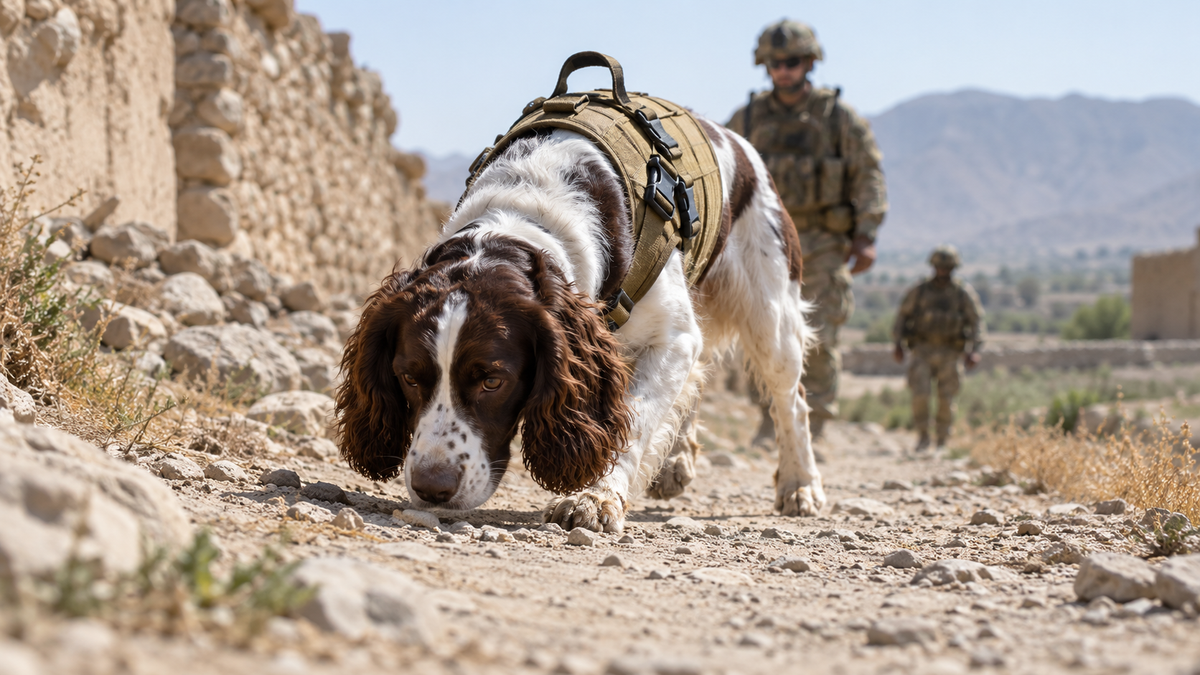
The English Springer Spaniel is a breed built around restless energy and a nose that seems never to switch off, originally developed in Britain to flush game from thick cover and search fields all day without tiring, often wanting more work even after a full day's effort. Theo, born in 2009, was a young, high-strung dog of exactly that kind, so excitable in his early training, in fact, that some trainers doubted whether he had the temperament needed for the discipline that serious operational bomb-detection work demands.
The handler who saw something others didn't
Then Theo was paired with Lance Corporal Liam Tasker, a British Army dog handler from Scotland, who saw past the restlessness that had worried other trainers to what Theo could actually become with the right kind of guidance. Together the two of them were deployed to Helmand Province, Afghanistan, and given one of the most dangerous jobs on any patrol: walking ahead of the soldiers to search for hidden bombs before anyone else in the patrol could step on one.
Fourteen bombs in five months
Theo found them, one after another. One. Then five. Then ten. In just five months of working together in the field, he and Liam located fourteen separate hidden bombs, more than any other dog-and-handler team in the entire war, an extraordinary record given the number of teams deployed across the conflict. They were so consistently effective, in fact, that the army made the unusual decision to extend their deployment by an extra month rather than rotate them home on the normal schedule.
March 1, 2011
On March 1, 2011, Theo and Liam were out on patrol when a sniper's shot rang out without warning. Liam fell. He was twenty-six years old. Theo, remarkably, was not hit at all.
Soldiers on the patrol brought them both back to Camp Bastion, the main British base in Helmand. A few hours later, with no visible wound on his body, no sign of poisoning, and no medical explanation the veterinary team on base could identify after examining him, Theo collapsed into a seizure. He never got up again.
A life worth remembering
Remember both lives behind the story.
"Where they should be"
Liam's mother, Jane, said afterward that she knew the reason for Theo's death, and that nothing any veterinarian said would ever convince her otherwise: Theo, in her words, had died of a broken heart. The two of them, handler and dog, who had worked and slept and walked together for months in one of the most dangerous provinces in Afghanistan, flew home to Britain on the very same military flight.
Liam was laid to rest in Scotland. His family made one specific, deeply felt request as part of the arrangements: that Theo's ashes be buried together with him, at his feet, so that even in death the two of them would not be separated. A year later, in formal recognition of the record the two of them had set together, Theo was posthumously awarded the Dickin Medal, the animal world's Victoria Cross.
"Liam and Theo are where they should be," his mother said at the time, a line that has since been quoted in nearly every account of their story.
Together every day, and on the last day too
For five months, Theo and Liam walked out together on patrol each day, and walked back together when the work was finally done. On the last day, in a way neither of them had any say over, they came home together one final time, handler and dog, buried side by side in Scotland. It's the kind of story that asks very little of the reader except to notice what's already there: if there's a dog lying quietly at your feet right now, it's worth a moment's thought for what that closeness can actually mean, and how far it can reach.
The hardest job in Helmand
Arms explosives search dogs like Theo were considered, by most accounts from soldiers who served in Helmand Province during this period of the war, among the most psychologically demanding roles in the entire British deployment, both for the dog, who had to maintain total focus scanning for buried devices across hours of patrolling in extreme heat, and for the handler, who bore the weight of trusting an animal's judgment with the lives of everyone behind them on the path. Dog-handler pairs typically trained together for months before deployment specifically to build the kind of seamless communication that Liam and Theo were able to achieve in such a short operational window, which is part of why their fourteen-bomb record in just five months stood out so sharply even among other highly rated teams serving at the same time.
A story that shaped public understanding of the bond
Theo and Liam's deaths, coming within hours of each other and under such unusual circumstances, received significant media coverage in Britain at the time, and the story is often cited in subsequent discussions of the close psychological and physiological bond that can form between military working dogs and their handlers over an intense deployment. Veterinary and behavioural experts who commented publicly on the case at the time were careful not to claim a scientific mechanism for Theo's sudden collapse, while also acknowledging that profound stress responses in dogs separated suddenly from a primary handler are a documented, if still not fully understood, phenomenon.
A record that still stands out among dog teams
Military records from the Afghanistan conflict document hundreds of individual dog-handler search teams across the full span of the war, deployed by multiple coalition nations working across different provinces and operating conditions. Within that much larger dataset, Liam and Theo's fourteen-bomb total in a five-month window remains frequently cited by British military historians as one of the standout individual performance records of the entire conflict, a statistic made more striking, rather than less, by how abruptly and tragically their partnership ended just as it was reaching that level of recognized success.
A burial request rarely granted
Military cemeteries in Britain do not routinely accommodate the burial of an animal's ashes alongside a human service member, and the decision to honour the Tasker family's request for Theo was, by most accounts, treated as an unusual and deliberate exception made specifically in recognition of the extraordinary circumstances surrounding both of their deaths. Veterans' affairs commentators have noted that the arrangement, rare as it remains, has occasionally been cited in subsequent discussions about how military institutions might better formally recognize the depth of the bond between service members and their working dogs, a conversation Theo and Liam's story helped bring into wider, more sympathetic public view.
A grief that reached well beyond one family
News of Liam and Theo's deaths, arriving within hours of each other and reported together as a single story rather than separately, drew an unusually large public response in Britain at the time, with messages of condolence arriving from well beyond the immediate military community Liam had served in. Jane Tasker's public comments about their shared burial were widely quoted in the following days, and the story is still periodically revisited in British media coverage of military working dogs, frequently cited as the moment that brought the full emotional weight of the handler-dog bond into mainstream public awareness in a way that more routine reporting on the conflict in Afghanistan rarely managed to achieve.
Military charities supporting bereaved service families have since referenced Theo and Liam's shared burial specifically when advocating for broader formal recognition of handler-dog partnerships within the armed forces, pointing to the public sympathy their story generated as evidence of how deeply the wider public already understands bonds that military institutions have not always been structured to formally acknowledge.
Remember the name
Theo at a glance
- Breed: English Springer Spaniel
- Born: 2009
- Handler: Lance Corporal Liam Tasker, British Army, from Scotland
- Known for: Locating fourteen hidden bombs in five months in Helmand Province, Afghanistan, more than any other dog team in the war
- Died: March 1, 2011, hours after Liam Tasker was killed by sniper fire; cause undetermined by veterinarians
- Honor: Dickin Medal, awarded posthumously in 2012
- Legacy: Theo's ashes were buried with Liam Tasker, at his feet, in Scotland
Further reading: Theo, PDSA Dickin Medal citation, Tributes to soldier and dog killed in Afghanistan, BBC News
Love Theo's story? Shop the Theo Sweatshirt and bring it home.
The story stays with us
Remember Theo.
Explore the tributes inspired by Theo's story, or meet another dog whose life deserves to be remembered.