
The story behind the tribute
Trakr: The Last Survivor of Ground Zero
A remarkable life. A lasting bond. A story that deserves to be remembered.
The life behind the tribute
Remember Trakr.
He had already retired. Then he watched the towers fall on television, and a police officer who hadn't been asked to come spent fifteen hours driving through the night just so his old partner could try to help.This is the story of Trakr, a retired police dog whose unscheduled journey to Ground Zero led to the rescue of the last survivor pulled from the World Trade Center wreckage, and whose unusual afterlife, through genetic cloning years later, made international headlines of its own.
Born in Prague, trained in Canada
Trakr was a German Shepherd, born in Prague and later trained as a working police dog in Halifax, Nova Scotia, Canada, by an officer named James Symington. The two of them worked together as an active police team for six full years, handling the kind of routine and occasionally dangerous police work that forms the backbone of any K9 unit, before Trakr's formal service came to its planned, scheduled end in May 2001. By every normal measure, his working days were supposed to be entirely over at that point.
September 11th changes the plan
Then came September 11th, 2001. James, like millions of other people around the world, watched the World Trade Center towers collapse live on television, and found that he simply couldn't sit still and do nothing in response. Acting entirely on his own initiative, he put Trakr in his car and drove through the night, a journey of roughly fifteen hours, covering the full distance from Canada down to New York City.
Nobody in any official capacity had asked them to come. It was a purely voluntary decision, made by a retired officer and his retired dog, to try to help regardless.
Reaching Ground Zero
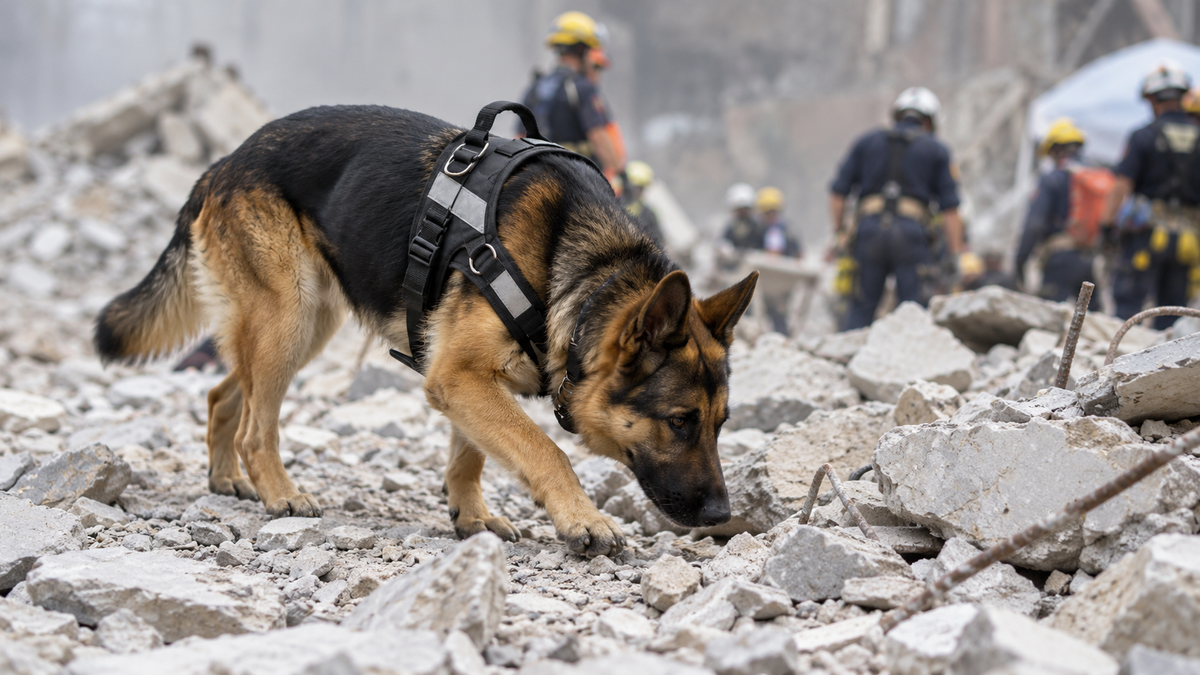
They reached Ground Zero on the morning of September 12th, less than a day after the attacks. Thick smoke still hung heavily over the entire site. Twisted structural steel and fires still smoldering beneath the visible surface made the whole area genuinely treacherous to move through, even for trained rescue personnel with proper equipment.
James brought Trakr onto the unstable rubble regardless. Nose held low, Trakr moved slowly and methodically across the wreckage, exactly as he had been trained to do years earlier in an entirely different context. Then he stopped abruptly, and gave the precise alert signal James had taught him years before, back during his ordinary working life as a police dog handling very different kinds of cases.
Someone was alive down there, buried beneath the debris.
Thirty feet down
Firefighters on site immediately began digging exactly where Trakr had signalled, down through layers of broken concrete and twisted steel, eventually reaching a depth of roughly thirty feet. And there she was: Genelle Guzman-McMillan, who had been trapped in the wreckage for more than twenty-six hours by that point, slowly running out of both time and air.
She would turn out to be the very last of the twenty survivors successfully pulled alive from the ruins of the World Trade Center, nobody found alive in the wreckage after her.
A life worth remembering
Hope is worth searching for.
Nearly two days without real rest
Trakr didn't stop after that single rescue. For nearly two full days afterward, he kept working at the site almost without meaningful pause, continuing to search long past the point most working dogs would reasonably have been rotated out for rest, until smoke inhalation, chemical exposure from the burning wreckage, burns to his paws, and sheer physical exhaustion finally forced him to stop entirely. He had given everything the site demanded of him, and then more, well past the point his official retirement the previous May had been specifically meant to spare him from ever having to do again.
A slow decline, and a decision
Years later, well after his service at Ground Zero had become a well-documented part of 9/11 history, Trakr developed a degenerative neurological condition that gradually robbed him of the use of his back legs. James restructured much of his own daily life around caring for his old partner through that difficult decline. Before Trakr eventually died, in April 2009, James made the unusual decision to enter a publicized dog-cloning contest, submitting genetic material taken from Trakr as part of the entry.
Five puppies, genetically his
That summer, five puppies arrived at James's door as a direct result of the contest: Trustt, Solace, Valor, Prodigy, and Deja Vu. They were genetic clones of Trakr, identical to him at the level of their DNA, though each one, inevitably and almost immediately, began growing into a life, a personality, and a set of experiences that were entirely and distinctly their own.
Unable to let go, and in a way, he never had to
James, by his own account, simply couldn't let go of the dog who had driven through an entire night with him to reach Ground Zero and ultimately helped find the very last survivor pulled from the wreckage there. In the most literal, scientific sense that modern cloning technology could offer at the time, he found a way not to have to. Though what Trakr actually gave on the morning of September 12, 2001, the product of a working partnership built over six formal years and then one final, unscheduled, fifteen-hour drive taken on faith alone, was never really the kind of thing any clone, however genetically identical, could fully replace.
One of hundreds who came without being asked
James and Trakr were far from the only search-and-rescue team to travel to New York entirely unrequested in the days immediately following September 11th, 2001. Search-and-rescue coordination in the chaotic early hours of any major disaster is notoriously difficult, and the influx of volunteer teams, some highly trained and others considerably less so, created real logistical challenges for the official response effort even as it also meaningfully expanded the number of searchers available at the site. Trakr's case stands out in retrospect partly because his specific find, locating the very last survivor pulled from the rubble, gave his unscheduled fifteen-hour journey a clear, documented, and ultimately undeniable outcome that many other volunteer efforts, valuable as they likely were, never received the same opportunity to demonstrate so concretely.
The cloning contest that followed
The 2008 competition James entered, organized by a California biotechnology company, was among the first publicly documented instances of a pet being commercially cloned in the United States, and it drew significant media attention at the time, both for the novelty of the science involved and for the emotional story behind James's specific entry. The five puppies born from Trakr's genetic material in 2009 were studied informally by researchers interested in canine behavioural genetics, examining the extent to which personality traits might or might not carry over through cloning, a question that, by most accounts from people who later worked with the puppies, had no simple answer, as each of the five developed into a distinctly different dog despite sharing identical DNA.
A record preserved in official 9/11 history
Trakr and James's account has since been incorporated into several official retrospectives of the September 11th search-and-rescue effort, including material maintained by organizations documenting first-responder and volunteer contributions to the disaster response. Genelle Guzman-McMillan, the survivor Trakr located, has spoken publicly in the years since about the specific moment rescuers reached her, thirty feet down and more than a full day after the towers fell, and has credited the search dog's work directly with the discovery that ultimately led to her rescue, one of the clearest, most personally confirmed outcomes attributed to any individual search-and-rescue dog working at Ground Zero in the attack's immediate aftermath.
A friendship that outlasted the search itself
Genelle Guzman-McMillan and James Symington have reportedly stayed in contact in the years following the attacks, their lives connected permanently by the roughly thirty feet of rubble that once separated a trapped survivor from the search team working to reach her. For James, the relationship with Genelle became, by his own account, one of the clearest and most personally meaningful confirmations of why he had made the unscheduled fifteen-hour drive in the first place, not an abstract act of service, but one specific person's life, directly traceable to one dog's trained nose and one decision made, without being asked, to drive through the night rather than stay home.
Remember the name
Trakr at a glance
- Breed: German Shepherd
- Born: Prague; trained as a police dog in Halifax, Canada
- Handler: Officer James Symington
- Known for: Locating Genelle Guzman-McMillan, the last survivor pulled from the World Trade Center rubble, on September 12, 2001
- Died: April 2009
- Legacy: Cloned via a 2008 competition; five puppies (Trustt, Solace, Valor, Prodigy, and Deja Vu) were born from his genetic material
Further reading: Trakr, Canadian search dog of 9/11, CBC News, Best Friends Again: the dog-cloning contest and Trakr, The New York Times
Love Trakr's story? Shop the Trakr Sweatshirt and bring it home.
The story stays with us
Remember Trakr.
Explore the tributes inspired by Trakr's story, or meet another dog whose life deserves to be remembered.